I'm the office administrator for a 140-person food ingredient company. I manage facilities and maintenance purchasing—roughly $180,000 a year across twenty-odd vendors. I report to operations and finance, which means I hear twice when a purchase goes sideways.
Our production floor in Bowling Green, KY is 55,000 square feet of concrete that never sleeps. "Clean enough" isn't a standard we get to choose. It's an audit standard.
When our old sweeper finally died last spring, the budget said "buy used." Honestly, I agreed. New scrubbers in the class we needed were coming in around $15,000–$22,000 from three dealer quotes we pulled. We had bigger line items coming.
So I found one. A used industrial floor scrubber from a dealer in Illinois. $4,200. 2,400 hours. The photos looked fantastic.
I almost wrote the check.
I'm glad I didn't.
The Machine Wasn't the Problem. What Happens After You Buy It Is.
I thought my problem was finding an affordable machine. That's the surface problem, the one every budget conversation starts with. But it's not the real problem. The real problem is what the machine costs you after it's sitting on your floor.
Seeing the two options side by side—$4,200 of mystery vs. $16,800 of documentation, warranty, and a dealer who returns calls—I finally understood what I was actually comparing. Not machines. Risk levels.
Here's the thing: an industrial floor scrubber isn't a pickup truck. You can't run it until it quits and just park it. It's production equipment, tied directly to a hygiene standard we're legally responsible for. When it's down, your floor doesn't get clean. And in food production, that's a problem with a capital P.
Batteries Will Eat Your Savings
Industrial scrubber batteries are deep-cycle packs, not car batteries. A new set costs $2,500 to $3,500 installed, and battery manufacturers rate them for roughly 1,500 charge cycles—about five years in daily single-shift use (typical OEM spec sheets, 2024).
The listing said the used machine had "12-month-old batteries." If I remember correctly, the dealer said that. Maybe it was true. But without a load test, a battery claim is just a sentence on a screen. And if those batteries were actually original? The $4,200 machine was about to become a $7,200 machine.
Parts Availability Is the Whole Game
At some point, your scrubber will break. That's not cynicism; it's physics. Brushes wear, squeegee blades wear, hoses crack. The question is whether it's down for three days or three weeks.
Parts availability decides that.
Before we bought anything, I called Factory Cat's parts operation in Milwaukee. Same-day shipping on wear items, they said. I asked about a pump for the model we were considering. In stock. I asked about lead times for a battery charger. Two days. That ten-minute call told me more than any brochure. Also worth noting: the model families share a lot of common wear parts, so the Milwaukee warehouse carries real depth, not just one SKU per machine. That's the kind of thing you can't see in a listing.
Then I called the Factory Cat dealer in Bowling Green, KY, about a floor scrubber we'd been comparing. They picked up on the second ring. I asked for the operator manual and the error code reference for the model. They emailed both the next morning—and each error code had a cause, a check, and a fix. We hadn't bought a thing from them yet.
Compare that to the Illinois seller, who said "I'll check" when I asked for service records, and then went quiet for a week. Real talk: that silence told me everything.
Documentation Is the Unsexy Difference
When a scrubber throws an error code at 6:45 AM, you don't want a ticket system. You want a manual and someone who can explain what the code means. Our production manager is handy, but he's not a technician. He needs documentation that turns a fault code into a fix.
That's the part nobody puts on the price tag. A used machine with no manual and a seller who can't explain error codes isn't discounted equipment. It's a guessing game.
What That "Deal" Would Have Really Cost
The production manager was pushing to just buy it. Every day without a working sweeper meant hand-scrubbing a floor that never stops. I get the pressure—that's why "just buy the cheap one" is so tempting. But that's exactly when the expensive mistakes happen.
Let me put numbers to it. These are estimates, not certainties—which is exactly the point.
- Used scrubber: $4,200
- Battery replacement (if the "12-month-old" batteries weren't): $2,800–$3,500
- Service call for a charging error the previous owner never mentioned: $650
- Two weeks of downtime waiting on a $90 part: whatever a dirty floor costs a food facility.
That last line is the one that matters. A dirty floor in a food plant isn't ugly; it's an audit finding. And in food production, sanitation isn't optional—it's the product we sell. According to OSHA (osha.gov), slips, trips, and falls are among the leading causes of workplace injuries, and floor conditions are a major contributor. I don't want to explain a hygiene audit failure because I tried to save $12,000 on a scrubber.
And I'll be honest: I've made this mistake before, just smaller.
A few years back, I bought a used parts washer without checking whether parts were still made for that model. It broke in month four. Six weeks of phone calls, and I finally gave up and bought new. Looking back, I should have checked parts availability before I bought it. At the time, it seemed like overthinking.
The repair guy who diagnosed it—about thirty years in the trade—said something I've never forgotten:
You buy the parts support, not the machine.
I knew I should verify battery condition and parts availability before buying that used scrubber. But the price was so good. What are the odds, right?
The odds. That's how the parts washer story ended.
What I Check Now Before Buying Any Sweeper or Scrubber
If you're looking at an industrial floor scrubber, a floor sweeper, or even a barn floor sweeper, here's the short version of what I learned. It applies equally to a $20,000 ride-on scrubber and a $6,000 barn machine. None of these questions mention "new vs. used," and that's intentional.
- Where do parts ship from? Same-day or two-day means the machine works. Three weeks from overseas means your floor doesn't get cleaned. Call and ask before you buy.
- Who answers the phone? A dealer who picks up and knows the machine is worth more than a warranty from a website.
- Can you get the manual and error codes before you pay? If a seller won't share documentation, walk away.
- What do wear items cost over five years? Brushes, pads, squeegee blades, filters. Annualized, this can rival the purchase price.
- If it's used, get a battery load test. Not a photo. A test.
- Is the model still current? Discontinued models mean discontinued support. And eventually, discontinued parts.
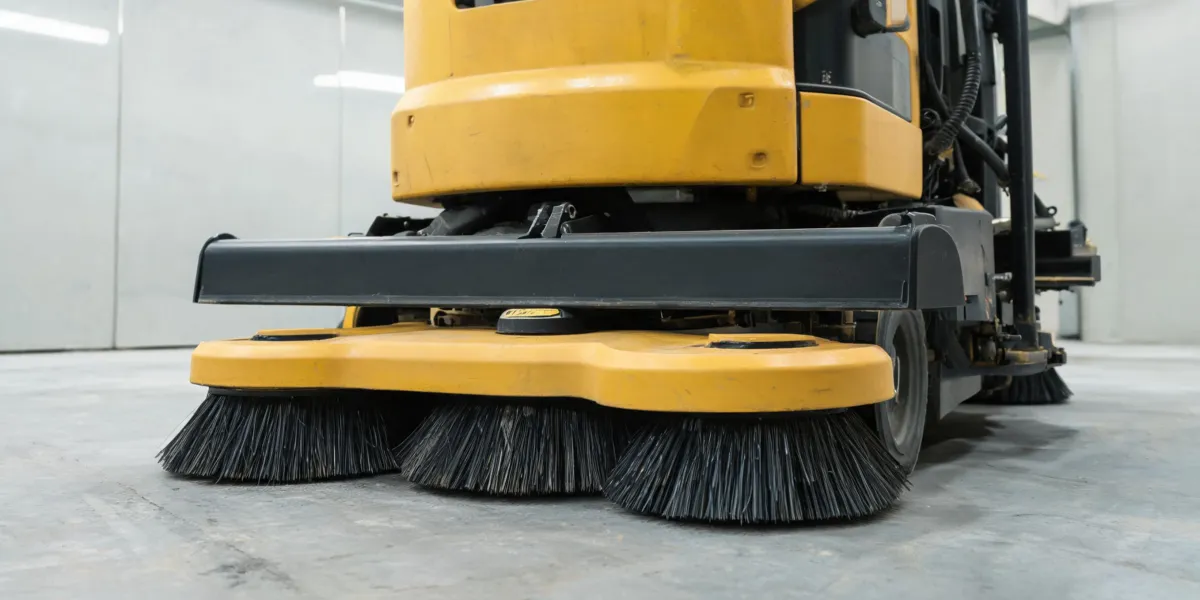
We ordered the Factory Cat from the Bowling Green dealer in the end. 55,000 square feet, one machine, zero unplanned downtime in 18 months. The parts come from Milwaukee when we need them—which has been exactly twice, both wear-item orders.
We also run a barn floor sweeper in the raw-material barn, where dust settles on everything within 24 hours. Same logic: simple, serviceable, and parts I can actually get.
Our Boise branch—2,000 miles from Kentucky—runs a Factory Cat floor sweeper for the same reason. Not because the machine is flashy. Because when it needs something, the answer is a phone call and a tracking number, not a shrug.
The Cheapest Machine Is the One That Runs
Here's the thing I tell anyone who inherits a buying decision: efficiency is a competitive advantage, and it starts with the boring stuff—parts, documentation, and a dealer who returns calls. The cheapest machine on the lot is the one that's running. A machine that's 5% cheaper but down 10% of the time is the most expensive machine you'll ever buy.
A used machine can absolutely be a smarter buy than new—if you do the homework. But the homework is the whole game. Skip it, and the deal you saved $12,000 on will find a way to cost you $20,000. Prices as of early 2025; verify current quotes.
In the end, I didn't buy the $4,200 machine. I bought the $16,800 one. It's been the cheaper one, every single day we've owned it.

Leave a Reply