Row 612 in my cost tracking file
I run procurement for a 380-person food processing operation. Six years managing our facility maintenance equipment budget — roughly $340,000 a year — and somewhere north of 40 vendors in that time. Every invoice, every service call, every part number goes into a cost tracking file. Right now it has 1,847 rows in it.
Row 612 is the one that changed how I buy floor scrubbers.
We bought a walk-behind unit in 2020, a little under $9,000. By early 2022 it was parked in a corner of the packaging hall with a fault code blinking on the display. Nobody knew what the code meant. We mopped around it for eleven days waiting on a tech who had to drive in from two states away. Then we bought a replacement, because that's what you do when a machine stops working.
That was the wrong reaction. It took me another two years to understand why.
What's actually going wrong
The machine was rarely the problem
When a scrubber dies, the default assumption is that it was a bad machine. Sometimes that's true. More often, in my experience, it's one of three things:
- It was specced for a building that isn't yours.
- It was bought without checking where the nearest parts and service actually sit.
- Nobody on your team knew how to read the diagnostics.
I want to spend most of this on the first one, because that's where most of the money goes — and most buyers never do the measurement work.
You have to spec the room, not the catalog
Here's a basement floor scrubber example that I use in every internal training now. We have a below-grade receiving area under the main plant. Ceiling height is 9'2" in the good spots and drops to about 7'8" under the old ductwork. The ramp down is 11 degrees. The drain is in the wrong corner. The door from the stairwell is 34 inches wide.
We put a standard 32-inch walk-behind in there. On paper it fit.
In practice, the machine couldn't recover water fast enough on the ramp grade, so it left a trail. The squeegee assembly had to come off to get it through the 34-inch door, which meant someone had to reinstall it every single time. And the battery compartment sat right at the low point of the ceiling, so the maintenance guys were doing battery service on their knees in a puddle.
None of that shows up on a spec sheet. All of it shows up in labor hours.
What I measure now, before any scrubber conversation:
- Narrowest door and narrowest aisle the machine will travel
- Lowest overhead obstruction on the route
- Ramp grades, if any
- Drain locations and floor slope
- Whether the machine ever has to ride an elevator
- Ambient humidity in the space, if it's below grade
Two hours with a tape measure has saved me more money than any negotiation I've ever run.
Then there's the parts and service map
From the outside, buying a scrubber looks like buying steel. The reality is you're buying a service radius.
People assume the machine price is the machine cost. What they don't see is what happens in month 19 when a drive motor or a brush deck component goes. If your nearest stocked parts source is a two-day freight run, a $260 part becomes a $4,000 problem once you count downtime, overtime labor, and the work that didn't get done.
I tracked this. Across 40-odd machines over six years — scrubbers, sweepers, burnishers — units with a stocked parts source inside a four-hour drive had, best I can tell, roughly a third of the annual downtime hours of units without one. I say "roughly" because our downtime logging wasn't as clean in the early years as it is now.
This is where regional concentration starts to matter. Factory Cat parts and service support is concentrated through Wisconsin and Kentucky, which is genuinely useful if you're operating in the upper Midwest or the mid-South — and genuinely a factor to weigh if you're not. A facility running a commercial floor scrubber in Memphis TN, for instance, sits reasonably well relative to a Kentucky-based parts pipeline. A facility in coastal Oregon does not. That's not a knock on the brand; it's just geography, and geography is a line item.
The part nobody wants to hear
What most people don't realize is that a large share of "broken" floor machines are sitting on a fault code that a competent operator could have cleared or diagnosed in under an hour — if anyone had the manual and the code table within arm's reach.
That eleven-day outage in row 612? The code was a low-voltage condition. Bad battery, probably. We found that out after the tech arrived and charged us for the trip.
I'm not saying every fault is a false alarm. I'm saying that a machine with published error code documentation and an operator who knows where to find it converts a $2,000 service event into a $300 battery replacement more often than you'd expect.
When I evaluate the floor scrubber market now, documentation availability ranks above almost everything else. Manuals. Error code tables. A parts diagram that matches what's actually bolted to the machine. It's boring and it's the single biggest lever on downtime.
What this costs when you get it wrong
Let me put real numbers on the wrong decision, because "efficiency" arguments don't survive budget season.
Capital churn. If a machine gets replaced at year three instead of year eight, you're paying roughly 2.7x per year of service life. On a $9,000 unit, that's the difference between $1,125/year and $3,000/year in capital cost alone. Multiply by a fleet of six.
Labor rework. Every time a scrubber misses a section, someone mops it. I costed this out for one of our production halls — 40 minutes a day of rework at fully loaded labor works out to about $4,900 a year. For one hall. That number embarrassed me enough that I stopped arguing about the equipment line item.
Risk. This one isn't theoretical. Per OSHA (29 CFR 1910.22), walking-working surfaces must be maintained "in a clean and, to the extent feasible, in a dry condition." Slips, trips and falls are consistently among the leading categories of workplace injury, and food processing floors are about the worst-case environment for them. A floor scrubber that under-recovers water isn't a maintenance annoyance, it's an exposure.
Perception. In my opinion, this is the cost that gets dismissed most often and matters most. When a customer, an auditor, or a prospective client walks into your facility, the floor is the first thing they register. Not the equipment list, not your certifications. The floor. A dull, streaked, faintly sticky floor reads as an operation that doesn't have its act together, even if everything else is airtight.
I've watched that play out in sales tours. We spent a year chasing a co-packing contract, and the feedback we got back after the plant walk was that our packaging hall floor looked "tired." Nothing else. That's what a worn squeegee blade cost us.
If you're making environmental claims about your cleaning process or chemistry, note that the FTC's Green Guides (16 CFR Part 260) require those claims to be substantiated — a product marketed as "recyclable" should be recyclable where at least 60% of consumers have access. "Green" is a claim, not a vibe.
How I buy now
I stopped starting with quotes. The current sequence is:
1. Walk the route with a tape measure. Doors, aisles, overheads, grades, drains. Write it down.
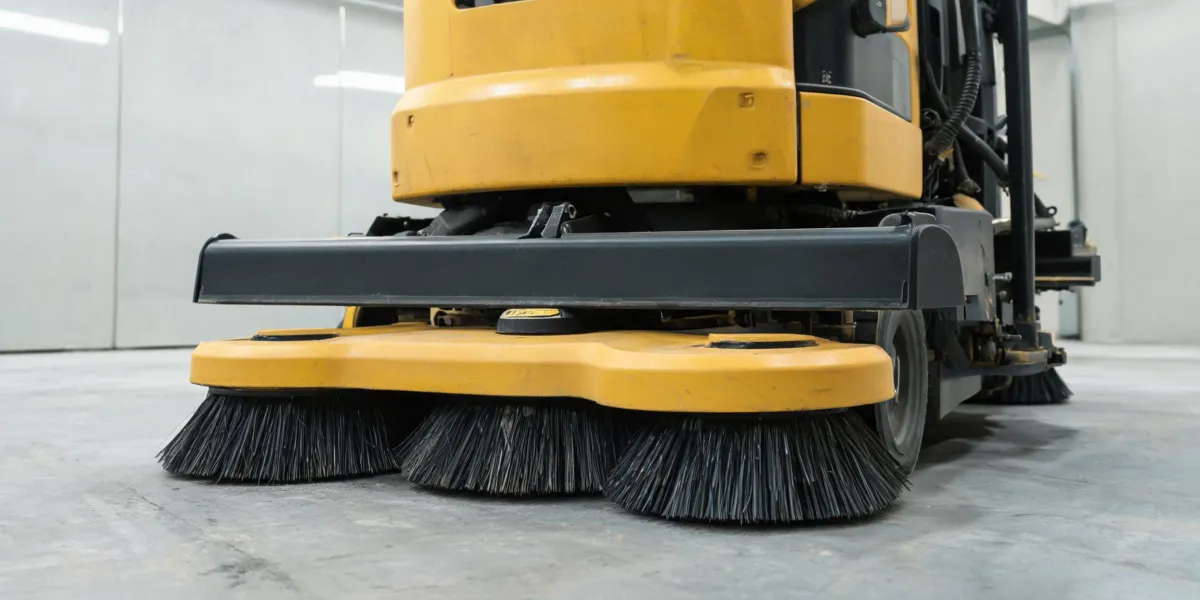
2. Match the machine to the route before the price. Tight aisles and low clearances point toward a compact walk-behind — something in the Factory Cat 34 class, which is built around the kind of constrained spaces that kill bigger machines. Open production floors and long runs push toward ride-on units like the Magnum or XR, where operator fatigue over a long shift becomes the real cost. Cramped, awkward below-grade areas are where something like the Micro HD earns its place.
3. Check the parts radius before the invoice. I want a stocked source inside a four-hour drive or a next-day freight lane. This is the check that changed our numbers the most.
4. Confirm documentation exists. Manuals, error code tables, parts diagrams. If a vendor can't produce them during the sales process, that tells me something about month 19.
5. Then talk price. Equipment in this class generally runs somewhere in the $6,000–$25,000+ range depending on size and configuration (based on dealer quotes I collected through Q1 2025; verify current pricing, since this moves).
Everything in steps 1 through 4 is free. It just takes an afternoon.
The short version
Your scrubber probably isn't failing because it was cheap. It's failing because it was bought for a building that doesn't exist, supported from too far away, and operated by people who were never given the documentation.
Fix those three things and the machine you already own starts looking a lot better. Fix them before you buy, and you keep it for eight years instead of three.
Take that with a grain of salt — I'm a procurement guy, not a mechanic. But I do have the spreadsheet.

Leave a Reply