-
Before we start: what this checklist is and isn't
-
Step 1: Verify the machine's actual hours, not the stated hours
-
Step 2: Battery systems are where the money goes
-
Step 3: Test the brush deck pressure through its full range
-
Step 4: Pull the error code history
-
Step 5: Verify parts availability before you buy, not after
-
Step 6: Get the manuals before the money changes hands
-
Common mistakes I still see people make
-
When you can skip this checklist
-
The payoff
I manage maintenance for a 180,000-square-foot industrial facility in the Milwaukee area. For the past nine years, I've been the person responsible for keeping our floors presentable across three buildings. In that time, I've personally made—and documented—14 significant equipment purchasing mistakes. Combined, they cost us roughly $24,000 in wasted budget. One reconditioned floor scrubber alone ate $8,500 of that.
I'm not in sales. I'm not a dealer. I just maintain the team's buying checklist now, and I'd rather share it than have you repeat my errors. Because trust me—they were avoidable. Embarrassingly avoidable.
This checklist is for facility managers, maintenance supervisors, and distributors considering a reconditioned floor scrubber, a ride-on sweeper, or a heavy-duty electric floor scrubber. Six steps, in the order that matters.
Before we start: what this checklist is and isn't
This applies to purchasing reconditioned equipment, and to verifying new equipment before you accept delivery. If you found your way here through a search term like "lovedoll toy factory cat"—which I've seen in our site analytics a few times—I can't help you there. My expertise starts and ends with industrial floor care equipment. That's the boundary, and I'm comfortable with it.
Step 1: Verify the machine's actual hours, not the stated hours
My worst mistake, 2018: I bought a reconditioned scrubber with 1,100 hours on the meter. Looked great. The meter read 1,100. What I didn't realize until weeks later was that the hour meter had been replaced along with the control panel. The machine actually had north of 4,000 hours on its drivetrain.
Here's how I check now: ask for service records, not just the meter reading. Look at the wear on the squeegee blades, brush deck, and tires—wear patterns tell you more than any meter does. And ask directly whether the hour meter was ever replaced. If the answer is "I don't know," treat the reading as unverified.
I don't have hard data on how often hour meters get swapped, but based on the machines I've inspected over the years, my sense is that it's more common than anyone in the used equipment business is eager to admit.
Step 2: Battery systems are where the money goes
This is the step I now tell everyone to check first, and it's the one most people ignore. A reconditioned scrubber might be priced at $7,000. But if the batteries are four years old, the real cost jumps by $2,500–$4,000 (based on quotes from two Milwaukee-area battery distributors, January 2025). That's not an accessory—that's a fundamental part of the machine.
The check: look at the battery casing date stamps. Confirm the batteries match the model's required amp-hour rating. Ask about the charger, because a mismatched charger can ruin a fresh battery bank in six months.
The mistake that stung: in 2022, I ordered a heavy-duty electric floor scrubber that was priced well. I didn't check the date stamps. I assumed reconditioning included batteries. It did not. That was a $3,200 lesson—no, to be accurate, it was $3,400 with the freight cost. I was mixing it up with a different invoice.
Step 3: Test the brush deck pressure through its full range
Every scrubber has a brush deck that applies downward pressure. Too little, and the machine just polishes the dirt. Too much, and you're burning through brushes and wearing the deck prematurely.
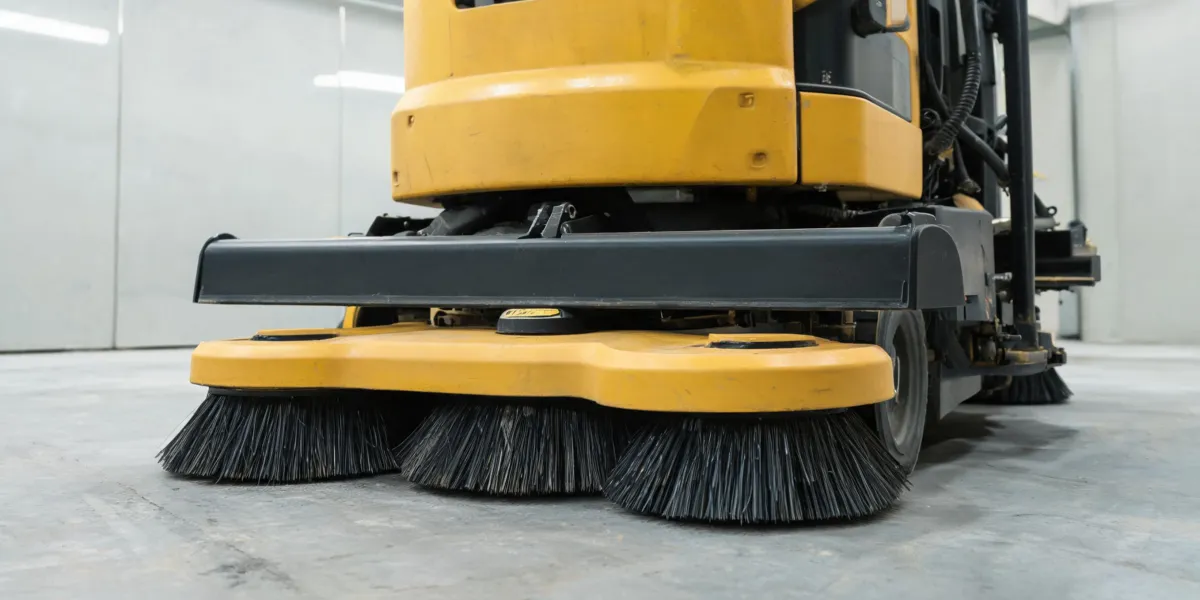
Most people test a machine by driving it over a dirty spot. That's a start. But the thing I learned the hard way: test the pressure adjustment mechanism itself. On a used unit, the adjustment points can be seized, stripped, or worn out.
The test I use now: run the machine on a visibly dirty floor, adjust the brush pressure through its complete range, and listen. The motor pitch should change noticeably. Then re-run the same patch to see if the adjustment holds. If a dealer won't let you do this, that's a red flag. Maybe I'm being overly cautious—but I've bought two machines with broken deck adjustments, and both turned $8,000 purchases into $11,000 repairs.
Step 4: Pull the error code history
Most modern scrubbers have onboard diagnostics. What most buyers don't realize: the machine's error history is often still stored in the controller.
If you're looking at a factory-cat scrubber—or any major brand, honestly—ask for the error code history before you commit. This can reveal:
- Recurring overheating faults
- Brush motor overwork patterns
- Repeated battery or charging issues
- Irregular service intervals
In Q4 2023, a dealer showed us a used ride-on sweeper and called a recurring steering fault a "minor electrical gremlin." We asked for the error log. Same fault, 14 times over two years. We walked. That's why error code support matters—factory-cat actually publishes error code documentation and keeps manuals available, which is a big reason we run some of their machines in our fleet. Not every brand does that, and the difference shows up the first time a machine goes down.
Step 5: Verify parts availability before you buy, not after
This is the boring step, which is exactly why people skip it. I learned the hard way in 2021.
I bought a used rider sweeper at a fair price from a dealer who promised parts were "easy to get." Then we needed a replacement squeegee assembly. Discontinued. Four weeks of downtime and $700 in expedited fabrication later, I now do this before every purchase:
Call the manufacturer or an authorized parts distributor with the serial number. Ask specifically about brush deck components, squeegee blades, filter or bag options, wheel assemblies, and control panel parts. Ask whether any of those are proprietary, single-source parts. If you're in the West Allis or greater Milwaukee area, this geographic piece matters more than people think. Factory-cat's parts and service are concentrated in Wisconsin and Kentucky, which means Midwest facilities get shorter lead times than brands shipping from across the country. I can't quantify their exact fill rates, but in our experience, the difference shows up in days, not weeks.
Step 6: Get the manuals before the money changes hands
This sounds trivial. It's not. A machine without its manual becomes a mystery box the moment something breaks.
What I ask every seller for, in writing: the operator's manual, the parts manual, the service manual, and the wiring schematic. If a reconditioned unit comes from a reputable dealer, these should be available. If they're not, that's information.
Why does this matter in practice? Because when a machine is down, the difference between a two-hour fix and a two-day fix is usually documentation. We've caught 47 potential errors using this checklist in the past 18 months, and I'd estimate a third of them were documentation-related—missing manuals, manuals for a similar-but-different model, or schematics that didn't match the actual wiring. And if you're looking at a magnet floor sweeper specifically, getting the manual matters even more. The magnet height adjustment and the gap between the magnet plate and the floor surface are precision specs. If you get those wrong, the machine looks like it's picking up debris, but it isn't. The manual tells you the numbers.
Common mistakes I still see people make
Mistake 1: Assuming "reconditioned" means the same thing everywhere. It doesn't. One dealer's reconditioning means new brushes and a coat of paint. Another's means new batteries, hoses, and squeegees plus a full service log. Ask for a written list of exactly what was replaced and inspected.
Mistake 2: Buying on sticker price instead of total cost of ownership. A $7,000 machine with old batteries is more expensive than a $9,500 machine with new batteries. Do the math over five years. My experience here is based on about 30 equipment purchases. If you're buying a single machine for a smaller facility, your risk tolerance might differ, but the arithmetic still works.
Mistake 3: Skipping the test drive. People buy five-figure equipment without ever sitting in the seat. You wouldn't buy a used car that way. Run the machine on your actual floors if you can. Listen. Watch for warning lights. Pay attention to how it maneuvers.
Mistake 4: Not asking about the warranty. A reconditioned machine should come with some coverage—even 90 days on parts is better than nothing. If a dealer offers zero warranty, ask why. That said, I should note that warranty terms vary widely in this market, and no warranty doesn't automatically mean the machine is bad. It means you're carrying the risk.
When you can skip this checklist
One scenario: buying new equipment directly from a manufacturer with solid warranty and service support. But even then, I'd still do steps 4, 5, and 6. New machines have error codes too. Parts availability matters on day one, not just after the warranty expires. And on more than one occasion, we've received new equipment with incomplete documentation—it happens more than you'd think.
Also worth saying: if a vendor tells you "this isn't our strength, but here's who does it better," that's a vendor worth keeping. I'd rather work with a specialist who knows their limits than a generalist who overpromises. We've had exactly that experience with factory-cat more than once—they pointed us to a different configuration than what we initially asked for. It earned them more of our business, not less.
The payoff
There's something satisfying about an equipment purchase that ends without surprises. After the early mistakes—the $24,000 in waste, the missed deadlines, the 3am worry sessions—getting this process systematized has been worth more than any single deal.
The checklist doesn't catch everything. I would never claim it does. But it catches the expensive stuff, and in facility maintenance, that's what counts. Run these six steps before your next reconditioned floor scrubber, magnet floor sweeper, or heavy-duty electric floor scrubber purchase. And if a vendor questions why you're asking, that's your answer before you even ask it.

Leave a Reply