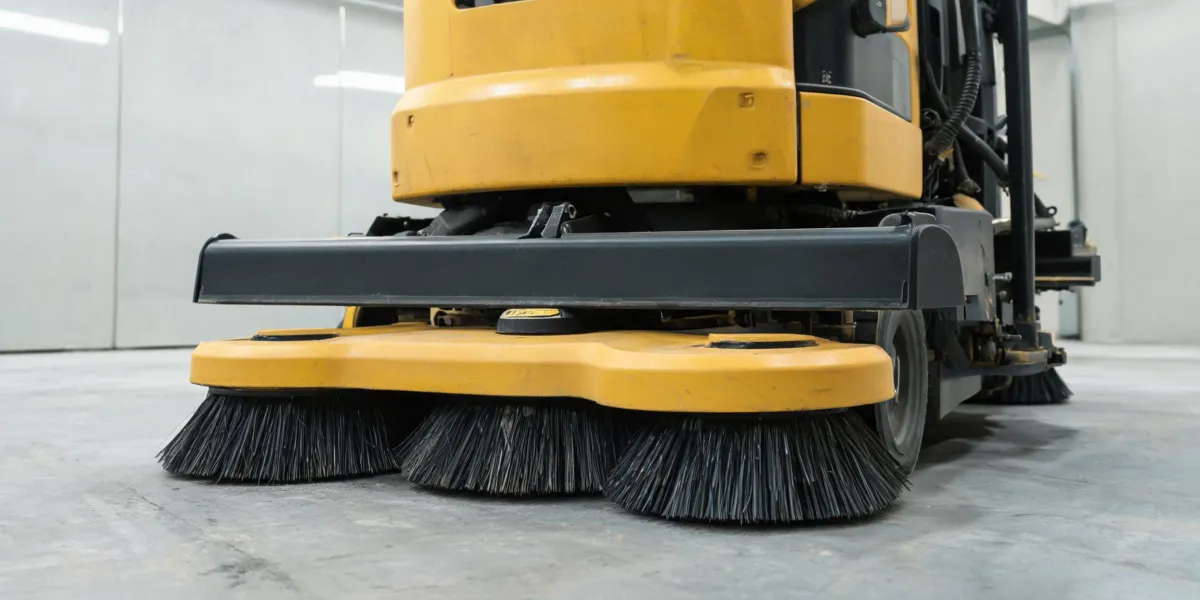
I don't care how low the sticker price is on a used floor scrubber if the vendor won't show me the all-in number before I sign. I'm the office administrator for a 220-person metal fabrication company. I handle facilities purchasing—roughly $210,000 annually across 14 vendors. I report to both operations and finance. I've been doing this since 2020. If a quote can't survive a finance review without surprise line items, it's not a good deal. It's a trap with a payment plan.
The "cheap" used scrubber that wasn't
In 2024, we needed a second scrubber for the weld shop. We found a used Factory Cat floor scrubber New Berlin listing for $3,900. The photos looked fine. The sales rep said it was "ready to work." Then I asked for an itemized quote. Freight: $450. Battery: $900. Charger: $325. Squeegee assembly: $180. Labor to install: $150. Total: $5,905. Finance had approved $4,000. I looked like the guy who forgot how math works.
We walked. Not because the machine was bad, but because the vendor hid the real number until we were emotionally committed. That's a red flag. We ended up buying a Factory Cat Mini HD floor scrubber from a dealer who gave us a line-item quote. Sticker was $6,100. All-in was $6,100. Higher sticker, way lower headache.
It's tempting to think you can just compare unit prices
It's tempting to think you can just compare unit prices. But identical specs from different vendors can result in wildly different outcomes. One quote includes a charger. Another doesn't. One has a battery with a 12-month warranty. Another has a battery pulled from a forklift. One provides the manual and error code list. Another says "we can email that later"—and later never comes.
"I've learned to ask 'what's NOT included' before 'what's the price.'"
That one question has saved me more money than any negotiation tactic. When we looked at a red floor scrubber—actually a T17 floor scrubber—the first quote was $180 cheaper than the second. But the first didn't include the squeegee, the hose, or delivery. The second did. Bottom line: the "cheaper" quote was $340 more expensive once we added everything.
Parts and service are where transparency really matters
Machines are the easy part. Parts are where vendors get creative. We run a Tornado Vortex 9" multi-surface floor scrubber for small areas. A replacement brush was listed at $60. Then came a $150 minimum order, $35 freight, and a $20 "small order fee." For one brush. I have mixed feelings about rush service premiums. On one hand, they feel like gouging. On the other, I've seen the operational chaos rush orders cause—maybe they're justified. But not when the fees are invisible until the invoice.
We also run a Factory Cat 34 and an XR—often written factory-cat in parts searches—and the local dealer in Wisconsin/Kentucky gives us parts diagrams and error code support without charging for a phone call. That's not a discount. It's a service. And it matters when a scrubber goes down on a Friday afternoon. The most frustrating part of vendor management: the same issues recurring despite clear communication. You'd think written specs would prevent misunderstandings, but interpretation varies wildly.
The counterintuitive argument: higher quote, lower cost
Here's the part that surprised me. The vendor with the higher upfront quote often costs less over 18 months. In our 2024 vendor consolidation project, we compared two used Factory Cat scrubbers. Quote A: $4,200. No battery warranty. No service history. No manual. Quote B: $5,400. New batteries. Six-month warranty. Full error code history. Manual included. Local service within two hours.
Quote A looked like the no-brainer. It wasn't. Over the next year, Quote A needed a new control board ($680), a charger ($325), and two service calls ($400). Plus downtime. Quote B needed one squeegee ($90). Net difference: Quote B saved us about $1,600—and a lot of apologizing to the night shift. Saved $1,200 by buying the cheaper machine. Ended up spending $2,800 on repairs and lost cleaning time. That's the penny-wise, pound-foolish pattern I keep seeing.
"But what if I just need a cheap scrubber for occasional use?"
Fair question. If downtime doesn't matter, if you can wrench on it yourself, and if you don't need documentation, then maybe the cheapest option is fine. But for most facility managers, downtime does matter. And hidden costs don't care about your budget.
A used red floor scrubber might be a T17 floor scrubber with an intermittent error code. If the vendor doesn't disclose it, you find out when the machine stops mid-aisle. A Tornado Vortex 9" multi-surface floor scrubber might need a proprietary pad driver that costs $200. A Factory Cat Mini HD floor scrubber might need a specific charger that isn't included. These aren't deal-breakers if you know about them upfront. They're deal-breakers when they show up after the invoice.
Also, watch the claims. Per FTC advertising guidelines (ftc.gov), claims must be truthful and not misleading. Per the FTC Green Guides (16 CFR Part 260), environmental claims like "eco-friendly" must be substantiated. So if a vendor says a scrubber is "green" or "maintenance-free," ask for the paperwork. Trust me on this one.
What I do now
I don't ask for the lowest price. I ask for the most complete price. I want a quote that includes freight, batteries, chargers, wear parts, setup, disposal fees, and any "core" charges. I want the error code list. I want the manual. I want to know who services it and how far away they are. If a vendor can't provide that before I pay, I move on.
We've done maybe 200 orders. Maybe 180, I'd have to check the system. But the pattern is consistent: the vendor who lists all fees upfront—even if the total looks higher—usually costs less in the end. That's not a theory. It's math I can take to finance without getting sent back for revisions.
So if you're shopping for a used Factory Cat floor scrubber New Berlin, a Factory Cat Mini HD floor scrubber, a red floor scrubber, a T17 floor scrubber, or a Tornado Vortex 9" multi-surface floor scrubber, start with the total cost. Not the sticker. The sticker is just the beginning of the story.

Leave a Reply