-
What I learned from a $3,400 savings
-
Most buyers miss the part that actually keeps a scrubber running
-
The industry has changed. Your purchasing criteria should too.
-
The service map is part of the spec sheet
-
What about the budget argument?
-
The weird searches are trying to tell you something
-
My updated rule for 2025
After five years managing facility purchasing, I think most companies still buy industrial floor scrubbers like it is 2015: they compare sticker prices, cleaning paths, and battery run times, then pick the lowest bid. That is backwards. In 2025, the machine is only half the purchase. The other half is the service ecosystem around it: parts, manuals, error code support, and a repair path that does not go dark when something breaks.
I am the office administrator for a 250-person company. I manage service orders and facility purchases, roughly $180,000 annually across eight vendors. I report to operations and finance. So I get it from both sides: operations wants the floor clean yesterday, finance wants the invoice to make sense.
What I learned from a $3,400 savings
In 2023, I approved a used scrubber from a broker because it was $3,400 cheaper than the quote from our regular supplier. If I remember correctly, the exact difference was $3,400, though I might be misremembering by a few hundred. The upside was obvious. The risk was not. I kept asking myself: is $3,400 worth the chance that we cannot get parts? I told myself it was a no-brainer.
It broke in three weeks. Not a catastrophic failure, just a control fault. But the broker had no manual, no error code list, and no parts diagram. Our local tech spent two hours guessing. We waited 19 days for a replacement sensor, maybe 17, I would have to check the service log. The production floor looked rough, and my operations manager asked me why we were saving money on the one thing everyone sees.
Finance did not reject the invoice. They rejected my next request for an emergency rental because the first purchase looked optimized. That was the real cost: credibility.
Most buyers miss the part that actually keeps a scrubber running
Most buyers focus on cleaning width and battery run time and completely miss parts availability, error code documentation, and whether a local tech can actually diagnose the machine.
The question everyone asks is, What is your best price? The question they should ask is, What happens when this throws an error code on a Tuesday morning?
That is not a small distinction. A scrubber is not a phone. You cannot swap it out for a newer model every two years without disrupting a facility. When a 34-inch walk-behind is down, someone still has to mop. That someone is usually already busy.
The industry has changed. Your purchasing criteria should too.
Five years ago, a floor scrubber was mostly mechanical. Today, even mid-range machines have sensors, battery management systems, fault codes, and sometimes telematics. A Dreame floor scrubber at home can clean a kitchen and send you an app notification. That is great. It also makes people think industrial equipment is equally plug-and-play. It is not.
Industrial machines live in dusty, wet, abusive environments. They hit pallets, run over shrink wrap, and get parked with dirty tanks. The advance in floor scrubber technology is real, but the advance I care about is not a bigger screen. It is the ability to pull a fault code, find the manual, and get the right part before the floor becomes a safety issue.
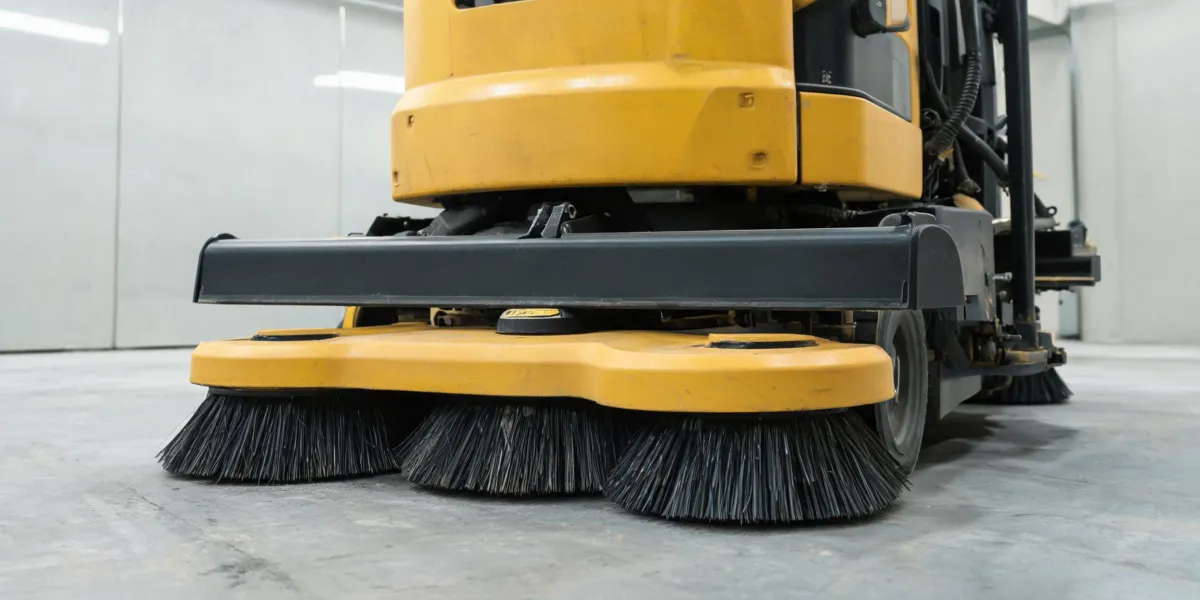
That is why model variety matters. A factory-cat lineup with 34, XR, Magnum, and Micro HD models can fit different aisles, budgets, and cleaning needs. But variety only helps if the support behind it is real. If you are looking at a factory cat sweeper for sale, do not just compare sweep path. Ask who stocks the filters, brushes, and squeegees.
The service map is part of the spec sheet
I used to treat geography as a nice-to-have. Now I treat it as a line item. A vendor with concentrated parts and service in Wisconsin and Kentucky may not be down the street from every facility, but that can still beat a local dealer who has to order every part from overseas. The question is not, Are you local? The question is, Can you get the part and walk my tech through the repair?
According to OSHA 29 CFR 1910.22(a)(2), the floor of every workroom must be maintained in a clean and, so far as possible, a dry condition. That is not an equipment mandate, but it makes the point: a down scrubber affects safety and compliance, not just appearance.
If you are searching for floor scrubber repair service Nashville TN, ask three questions before you book anyone:
- Do you stock parts for my model, or do you order them after diagnosis?
- Can you read the error codes and provide the manual section?
- If you cannot fix it today, what is the backup plan?
Those questions sound boring. They are also the difference between a two-day repair and a two-week headache.
What about the budget argument?
I know what some readers are thinking. Easy for you to say. My CFO only looks at purchase price. I have been there. I have also been the person explaining why a cheap machine needed a $900 repair in month two. So here is the thing: I am not saying price does not matter. I am saying price without a parts and service path is not a price. It is a guess.
What I mean is that the sticker price is only one line in the total cost. Calculate the worst case. The machine fails during a health inspection or before a customer tour. You rent a replacement at $400 per day. Your tech spends six hours chasing a part. The so-called savings disappear. The best case? The cheap machine runs fine for years. That happens. But expected value is not the same as a safe decision. The downside felt catastrophic, and in my case, it was.
Even after choosing the better-supported option later, I second-guessed myself. What if I paid more for the same result? I did not relax until the first error code appeared, we looked it up in the manual, and the local tech had the part on the truck. That is when I knew the premium was worth it.
The weird searches are trying to tell you something
I once had a request to spec a scrubber for a biscuit factory cat lounge. Long story. The details do not matter. What mattered was that the floor had food dust, moisture, and unpredictable traffic. The same logic applies whether you run a biscuit factory cat lounge, a machine shop, or a warehouse aisle. The equipment has to match the environment, and the service has to match the equipment.
If you are comparing a factory-cat machine to something cheaper, do not stop at the quote. Ask for the parts list. Ask for the manual. Ask for the error code guide. Ask who answers the phone at 6 a.m. when the scrubber will not start.
My updated rule for 2025
Buy the support network, not just the machine. The fundamentals of floor cleaning have not changed: scrub, squeegee, vacuum, dump, repeat. But the execution has transformed. Parts are more specialized. Diagnostics are more electronic. Downtime is more visible. What was best practice in 2020 may not apply in 2025.
So if you are looking for a factory-cat sweeper for sale, or trying to find floor scrubber repair service Nashville TN, or even replacing a small Dreame floor scrubber with an industrial unit, do not let the lowest bid make the decision for you. A floor scrubber advance part number is useless if nobody can install it. A cheap machine is expensive when it is sitting in the corner while your team mops.
That is my position: the cheapest industrial floor scrubber is usually the most expensive decision, not because cheap machines are always bad, but because cheap support always costs more than you think.

Leave a Reply