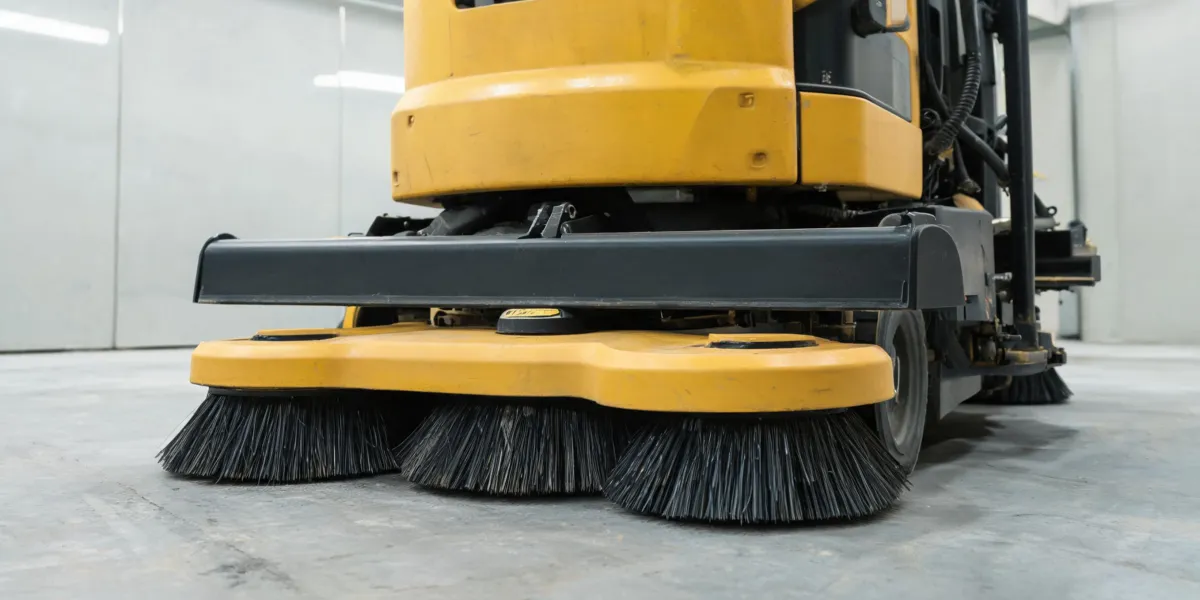
I am a procurement manager at a 180-person industrial services company. I have managed our cleaning equipment budget—roughly $180,000 over the last eight years—and every invoice goes into the same cost tracking spreadsheet. So when someone asks whether to rent a 50 in ride on floor sweeper or buy a Factory Cat TR sweeper, I don't give a one-word answer. I walk them through four comparison points: cash flow, true cost per hour, maintenance and downtime, and fit for the actual floor.
Here's the thing: this is not a 'renting is always smart' or 'buying is always better' argument. It depends on how often the machine runs, what it's sweeping, and whether you can handle the upkeep. But I can tell you what the spreadsheet usually shows after a year.
Dimension 1: Upfront Cost and Cash Flow
Renting has one obvious advantage: no $20,000 capital request. If you need a sweeper for a one-time cleanup after construction, renting is the only rational move. In March 2025, I requested quotes for a 50 in ride-on floor sweeper from two local equipment rental shops. The rates came back between $225 and $275 per day, or $1,100 to $1,400 per week, plus delivery. Four weeks of rental per year runs $4,400 to $5,600 before you add fuel and consumables. Over three years, that's $13,000 to $17,000 on a machine you don't own.
A Factory Cat TR sweeper is not cheap. Depending on dealer and configuration, you're looking at a five-figure purchase. But if you amortize it over a five-year lifecycle, the conversation changes. If I remember correctly, the TR quotes we saw in early 2025 landed between $16,000 and $21,000. At $1,200 per week in rental, that's 13 to 17 weeks of rental before the owned unit pays for itself.
So the first comparison comes down to approval speed vs. recurring cost. Rental wins when capital is frozen and the need is short. Ownership wins when the need is predictable.
Dimension 2: Total Cost Per Hour, Not Sticker Price
The rental rate is only the beginning. Every time you rent, you spend time on pickup and return, or you pay for delivery. You fill out papers. You inspect the machine for previous damage. If it breaks down, you wait for the shop to swap it out. That's not overhead—that's cost.
When I compared our Q1 and Q2 rental invoices side by side, I finally understood why the phrase 'death by a thousand cuts' exists. The $250 daily rate wasn't the issue. It was the $75 delivery fee, the $20 environmental charge, the extra $40 for a filter that was half clogged, and the 45 minutes my maintenance lead spent on a damage claim. The effective cost came out closer to $400 per rental day.
Let's do the math with rounded numbers. A rented 50 in ride-on floor sweeper at $250 per day plus fees is roughly $350 to $400 per day. If it runs four hours, that's $90 to $100 per operating hour. A Factory Cat TR at $18,000, with $2,500 in parts, service and consumables over five years and a resale value around $4,000, has a net cost of $16,500. Spread over 1,000 hours of operation, that's about $16.50 per hour. Even if the ownership number doubles, the rental still costs four times more per hour.
That math works for our facility—roughly 200,000 square feet of mixed concrete and packed dirt. If you're running a 5,000-square-foot shop, it changes everything. Total cost of ownership—i.e., not just the purchase price but all the costs around it—is the only number that matters.
Dimension 3: Maintenance, Downtime, and the 'Someone Else's Problem' Fallacy
Everything I'd read said renting is smarter because maintenance is the rental company's problem. In practice, it's still your problem. You're just at the back of their line.
The first 50 in ride-on floor sweeper we rented arrived with a clogged filter and a missing side brush. We paid for a machine that should have been ready to work. Instead, I spent two hours coordinating a swap, and the replacement unit had a cracked hopper seal. That's not a knock on every rental shop—most are stretched thin in peak season—but it's the reality of relying on someone else's fleet.
The surprise wasn't the rental price. It was how much time we lost to logistics: pickup windows, return schedules, and 'the other guy didn't bring it back' delays.
On the ownership side, parts availability is the real variable. Factory Cat's parts and service are geographically concentrated in Wisconsin and Kentucky. That's a critical detail. If you're close to one of those regions, or you have a dealer who stocks parts, the TR sweeper becomes much easier to own. If you're nowhere near a dealer, that's a genuine reason to keep renting. I'm not going to pretend geography doesn't matter.
Dimension 4: Barn Floor Sweeper vs. Blue Floor Scrubber
Let's clear up a common mix-up. A barn floor sweeper is a dry-debris machine. It picks up sand, bedding, manure, spilled grain, dust, and light construction debris. A blue floor scrubber is a wet-cleaning machine. It applies water and detergent, scrubs the surface, and vacuums up the dirty water. They are not interchangeable. If you drag a scrubber across a dry barn floor, you get mud. If you drag a sweeper across a greasy warehouse floor, you get a greasy trail of dust.
So the fit question is not just Factory Cat vs. rental. It's sweeper vs. scrubber. A Factory Cat TR sweeper is a barn floor sweeper at heart—it handles heavy dry debris, not just surface dust. But if your real need is wet wash-down duty, a blue floor scrubber is the correct tool. Factory Cat scrubbers are a different product line, and the TR is not secretly a scrubber.
The vendor who says 'this one does both' is the one I'd walk away from. I'd rather work with a specialist who knows their limits than a generalist who overpromises.
Which One Should You Choose?
Here's my practical, spreadsheet-leaning advice:
Buy the Factory Cat TR sweeper if: your floor is mostly dry debris, you'll use it more than 15 weeks per year, and you have a dealer or service route within reach. The TR earns its keep when it's part of a regular routine, not an occasional experiment.
Rent the 50 in ride-on floor sweeper if: this is a one-time or seasonal job, you don't have storage space, or you're still gathering data to justify a capital purchase. Rental is a data-gathering tool too. Use it to measure how many hours the machine actually runs.
Choose a blue floor scrubber if: wet cleaning is the actual need. Don't let anyone convince you a sweeper will do the same thing. And if you land on Factory Cat scrubbers instead, that's a different comparison—one where the TR is no longer the relevant model.
That last point matters more than the cost model. The vendor who says 'this isn't our strength—here's who does that better' is the one I trust for everything else. That boundary is what makes a specialist worth owning.

Leave a Reply