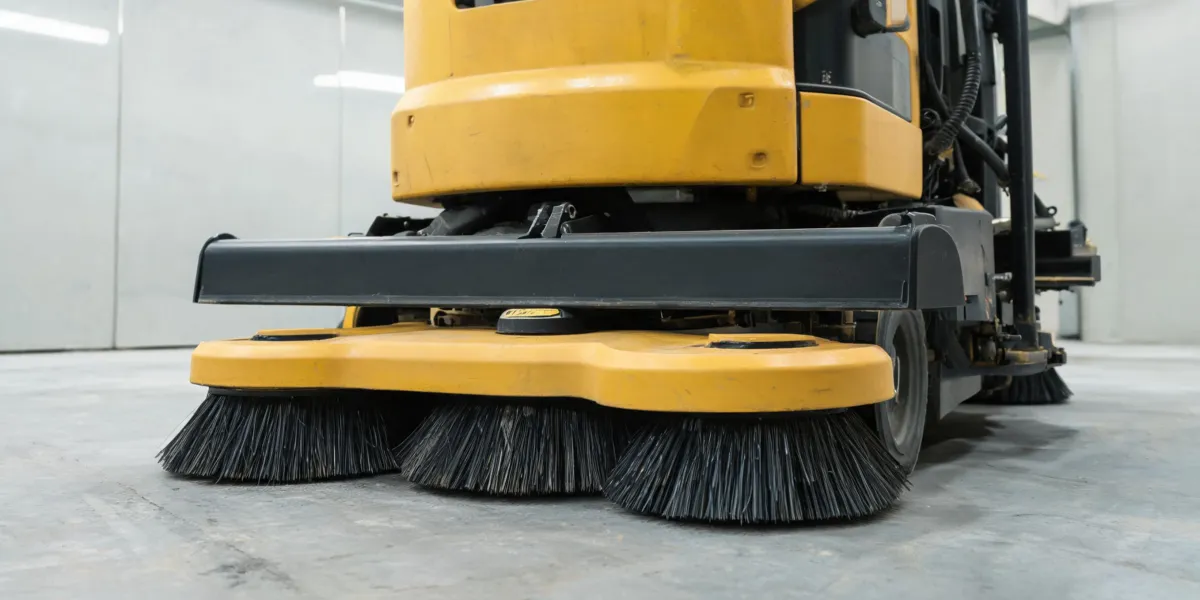
There's a long-running joke at our warehouse: we don't own a floor scrubber, we own a "zamboni floor sweeper." That's what Mike, my warehouse supervisor, calls it. Every time he takes it down an aisle, someone yells "ice is ready!" and he just shakes his head. Twenty years in facilities and the man still can't shake the ice-rink vocabulary.
I'm the office administrator for a distribution company in Birmingham, AL. About 170 employees, two buildings, and I manage all the facility purchasing—roughly $60,000 a year across 7 or 8 vendors. Maybe 8, I'd have to check the system. I took over this role in early 2022 and learned most of it by making mistakes. The big floor scrubber purchase was one of the bigger ones. It ended well, though. And if your search started with "factory cat floor scrubber birmingham al"—or if you're comparing big floor scrubber pricing in general—this story might save you a few thousand dollars.
When the old scrubber died
In early 2024, our maintenance budget got approved for a new ride-on scrubber. The walk-behind unit we'd been using since 2019 was limping—battery runtime down to maybe 45 minutes, squeegee blades replaced twice, and it just couldn't keep up with a 42,000-square-foot warehouse anymore.
So I did what I always do: collected three quotes. A national equipment dealer. A regional supplier. And... well, I'll get to the third one in a minute.
Here's mistake number one. The national dealer's quote came in at $18,400, roughly $1,600 below the regional supplier. I was about to push the purchase order through when something made me pause—maybe the fine print, maybe a gut thing. I called and asked, "What's NOT included in that price?"
Best question I ever asked. The answer turned a $1,600 "savings" into a $2,965 budget overage.
The hidden math
Turns out the "cheaper" scrubber didn't include:
- Freight: $380
- Battery and charger: $1,150—a "surcharge" on this model
- Setup and inspection: $475
- Operator training (mandatory, per the dealer): $350
- First set of brushes and squeegee blades: $610
Add it up: $2,965. The $18,400 quote became $21,365 before tax. The regional supplier's quote, which included almost everything except freight, suddenly looked like the real deal.
I'm not accusing the national dealer of being sneaky. That's probably just how their pricing model works. But the lesson stuck: the first number on a quote is rarely the number you pay.
Why I almost skipped Factory-Cat
The regional supplier mentioned Factory-Cat, and honestly, I'd never heard of them. I know the usual big names—Tennant, Nilfisk, the standard suspects. "Factory-Cat" sounded like a small brand, and I nearly didn't bother with a quote. Glad I did.
Their quote arrived as a single page. No "base price" followed by a column of add-ons. The machine, freight to Birmingham, setup, a full set of pads and brushes, and a two-hour training session for Mike—all on one line: $19,900. Oh, and they listed part numbers for the consumables in the quote, which I still think is unusual in a good way.
Naturally, I asked my new favorite question: "What's NOT included?"
The answer: installation if you need someone to bolt it down (we didn't), and any electrical work for a special charging station (we didn't need that either—standard 110V outlet near the maintenance room worked fine).
That's what sold me. Not the price—it was only $500 below the regional quote. The transparency. The one-page quote that just told me exactly what everything cost.
The Zamboni arrives (with an error code)
We ordered the Factory-Cat XR in March 2024. Delivery took about two and a half weeks—I was told 10-14 days and it showed up on day 17. Close enough, and honest enough that I noticed.
Mike was skeptical. He's a "buy once, cry once" guy. Paying $19,900 for a brand he'd never seen in a facility made him twitchy. The first week, he'd send me photos of the machine with the side panel off. Nothing was wrong—he was looking for problems. He was convinced we'd bought something too obscure to be reliable.
Then, around month three, something actually broke. The display flashed an error code—E-14, I think—and the machine wouldn't drive. Mike was polite, but I could feel the "I told you so" building up.
I called the support line. A rep in Wisconsin walked us through the diagnostic in about ten minutes. A sensor wire had worked itself loose, probably from hitting the dock plate (Mike always hits the dock plate). The rep emailed me the wiring diagram from the manual and stayed on the line while Mike snapped the connector back in. Total downtime: maybe 30 minutes.
The kicker? The rep said,
"If that happens again, call us direct. We'll send you a spare harness—no charge."And they did. It showed up three days later from their Wisconsin warehouse, no return authorization, no interrogation about whether we'd abused the machine.
Mike hasn't said "I told you so" since. He did say, "This thing's got more sensors than my truck." Coming from Mike, that's practically a standing ovation.
What about autonomous floor scrubbers?
During the same search, I looked into an autonomous floor scrubber for retail stores. We have a small showroom attached to the warehouse—maybe 6,000 square feet—and the idea of a robot quietly scrubbing the tile while we did paperwork was appealing. But the quotes I got were... a lot. Roughly three times the cost of a ride-on, plus a monthly software fee, plus a one-time "facility mapping" charge.
For our floor space, the math didn't work. To be fair, that's not a knock on autonomous machines. If you're running a retail store with a big footprint and minimal staff time for cleaning, an autonomous scrubber might be a no-brainer. But our building has a narrow hallway between the showroom and the warehouse, and the demo unit kept stopping at the threshold transition. The rep said it needed a "safety reconfiguration." I'm sure it's solvable—we just weren't the right test site. This worked for us because we have predictable, open warehouse space. Your mileage may vary with tighter layouts.
What I'd do differently
If I ever buy another big floor scrubber, here's what I'm leading with:
- Ask for the total out-the-door number on page one. Not the base price. The final number, with freight, setup, training, charging hardware, and consumables.
- Ask what's NOT included. That single question exposed $2,965 in add-ons on the national quote.
- Ask about error code support. Factory-Cat publishes theirs in the manual, which made our diagnosis simple. The first big-brand model I looked at didn't even include a printed manual as standard.
- Don't assume a lower base price stays lower. The $18,400 became $21,365. The $19,900 stayed $19,900.
I should be clear: I'm not a Factory-Cat employee or affiliate. I'm a customer who bought one machine and some consumables. If the quality had been bad, you'd be reading a very different post. But the transparent quote and the support we've gotten have made me a repeat parts customer, and that says more than any spec sheet.
Pricing reference
In case it helps, here's what we saw in February 2024 when shopping for a ride-on scrubber sized for a 40,000-50,000-square-foot facility:
- Factory-Cat XR, fully optioned: $19,900 including setup, training, and initial consumables
- Regional brand-comparable unit: about $20,000 plus freight ($420), setup ($350), training ($250), consumables (around $480)—roughly $21,500 all in
- National brand-comparable unit: $18,400 base, but $21,365 after mandatory add-ons
Prices as of February 2024; verify current rates before you commit.
Bottom line? The zamboni runs, Mike is happy, and I learned that the most dangerous number on any equipment quote is the one before the word "base." Start with "what's NOT included." It's a game-changer.

Leave a Reply