-
There's no one 'best' floor machine
-
Scenario 1 – Dry debris, dust, and packaging litter: get a sweeper
-
Scenario 2 – Wet spills, oily residue, or hygiene audits: get a floor scrubber
-
Scenario 3 – Labor is the bottleneck: consider a self-charging robot floor scrubber
-
Scenario 4 – Short-term need or equipment down: hire a machine
-
How to figure out which scenario you're in
I'm a service coordinator at Factory Cat. If you typed 'factory-cat' into a search bar, you're in the right place. Over the last six years, I've handled 300+ rush orders—plants that need a machine by 7 a.m., managers who find out about an audit 36 hours early, and facility teams that ordered the wrong type of cleaner. This guide is basically the conversation I wish every customer had before calling us.
First, one thing: If you found this page while looking for 'the biscuit factory cat lounge,' I'm sorry—that's not us. We're the other Factory Cat. We sell and service industrial sweepers and scrubbers, and yes, we've supplied machines to biscuit factories. No lounging cats, but we do keep floors clean enough to walk on safely.
There's no one 'best' floor machine
Honestly, the best machine depends on four things: square footage, floor condition, how often you'll use it, and who's going to operate it. A ride-on scrubber is a waste if your facility is 8,000 sq ft. And a walk-behind sweeper won't make a sticky spill vanish before an auditor shows up. So let's split it into four common scenarios. Find yours.
Scenario 1 – Dry debris, dust, and packaging litter: get a sweeper
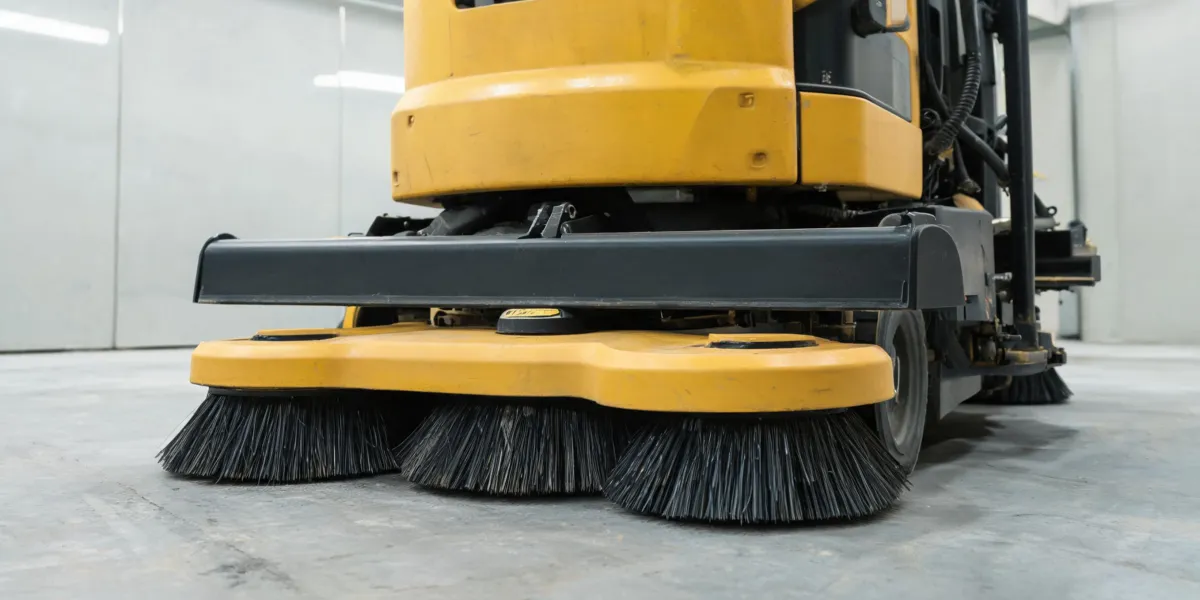
If your floor problem is mostly dry—dust, cardboard dust, pellets, dirt tracked in from outside—you need a sweeper, not a scrubber. Water only turns dry dust into mud. That's where a broom floor scrubber comes in. The term 'broom floor scrubber' is often used for a walk-behind sweeper with a broom-style main brush. It does the same job as a push broom, but a lot faster.
Our Factory Cat 34 is the machine we recommend for small to mid-size facilities. For larger plants, the Factory Cat GTR is a ride-on unit that can cover a warehouse floor in a fraction of the time it takes a crew with push brooms. It's also the machine we send on most same-day emergency calls because it's simple to operate and doesn't need much setup. I want to say it covers about 100,000 sq ft per hour, but don't quote me on that exact number. The point is, it's fast.
If you need a sweeper only for a one-off shutdown, construction clean-up, or a weekend event, consider sweeper machine hire instead of buying. Rental makes sense when you don't want to store, maintain, or baby a machine you'll use three times a year.
Scenario 2 – Wet spills, oily residue, or hygiene audits: get a floor scrubber
A sweeper won't remove the film on a food production floor. For that you need a floor scrubber—a machine that applies water and cleaning solution, agitates it with a pad or brush, and vacuums the dirty water back up. If your floor is sealed concrete, epoxy, tile, or vinyl, this is what keeps it both clean and safe.
You might hear people ask for a 'broom floor scrubber' when they mean a scrubber that also has a sweeping function, often called a sweep/scrub combo. Some models have a hopper or pre-sweep brush that picks up dry debris before the scrubbing head hits the floor. If your floor has both dry litter and sticky spots, that combo can be smarter than buying a separate sweeper and scrubber.
I still kick myself for not asking more questions about a customer's floor before we rushed them a sweeper. If I'd asked one question about the sticky spill in the packaging area, we'd have sent a scrubber instead. But the good news is that most rental and rush options let us correct that mistake in a day.
OSHA's walking-working surfaces standard (29 CFR 1910.22) says floors need to be kept clean and dry. Inspectors don't care whether you own, rent, or borrow the scrubber—they care that the floor isn't a slip hazard. In March 2024, a packaging plant called at 2:30 on a Friday afternoon. They needed a floor scrubber for an OSHA walkthrough on Monday. Their usual rental vendor said three weeks. We had a machine on site by Saturday morning. Missing that walkthrough would have meant a costly citation.
Scenario 3 – Labor is the bottleneck: consider a self-charging robot floor scrubber
This is the part where the industry has changed. What was true in 2020 about robotic scrubbers—too expensive, only for giant distribution centers—doesn't hold in 2025. We're now seeing 25,000 sq ft plants justify a self-charging robot floor scrubber, not necessarily because the floor is huge, but because they can't afford to have an operator spend four hours a day pushing a machine.
As a self-charging robot floor scrubber supplier, I get asked all the time whether robots replace people. They don't, completely. They replace the most repetitive part of the work. The key difference from a regular scrubber is the self-charging dock. The robot returns, recharges, and gets back to work on a schedule. You still need someone to add water, change the brush, and handle corners the robot can't reach. But if you're running two shifts and the floor needs cleaning during both, a robot can cut labor costs dramatically.
Everything I'd read said robots only make sense in mega-warehouses. My experience with dozens of automation conversations says otherwise. If you have consistent aisles and a repetitive cleaning route, a robot is worth calculating. If your layout changes constantly, stick with a manual machine. At least, that's been my experience.
Scenario 4 – Short-term need or equipment down: hire a machine
Sweeper machine hire isn't just for construction sites. We rent walk-behind and ride-on sweepers to facilities that are waiting for a part, covering a busy season, or dealing with a one-time mess. I've seen a client spend serious money on a sweeper for a four-day event and use it exactly twice. They would have been much better off hiring one.
I only believed in rental after we had a customer who bought a ride-on sweeper for a single warehouse clean-out. It sat in their shipping bay for eight months. The rental price for a week would have covered the whole job and left them with no storage headache.
How to figure out which scenario you're in
Here's the practical way to decide. Answer five questions:
- How many square feet are you cleaning? Under 20,000 sq ft, a walk-behind is usually enough. 20,000 to 100,000 sq ft, look at a ride-on. Over that, you may want a robot or multiple machines.
- What's the main floor contamination? Dry debris says sweeper. Wet spills and oily film says scrubber. Both says combo or two machines.
- How often do you need to clean? Daily or more means buy. A few times a year means hire.
- Who will run it? If labor is scarce, a self-charging robot is worth the higher upfront cost.
- What's the deadline? If you need a machine by tomorrow, hire or rush order. If you can wait two to three weeks, buying gives you more options.
If you're still not sure, use this shortcut:
- Dry floor, occasional use → sweeper machine hire.
- Dry floor, daily use → buy a sweeper (walk-behind or GTR).
- Wet or sticky floor, daily use → buy a scrubber.
- Sticky floor, occasional use → rent a scrubber.
- Consistent route, limited labor → ask about a self-charging robot floor scrubber.
According to ISSA's Cleaning Industry Management Standard (CIMS), documented processes matter as much as the equipment itself. I'd add that the right equipment makes the process easier to document. And if you're in a time crunch, the fastest way to get the right machine is to tell us your square footage, floor type, and deadline. That's the same information I ask every caller, because the answer is never 'one machine fits all.'
Bottom line: if you need a floor clean on a deadline, use the scenario that matches your situation. And if you're not sure, don't guess—a quick call with a real person is cheaper than a wrong machine.

Leave a Reply