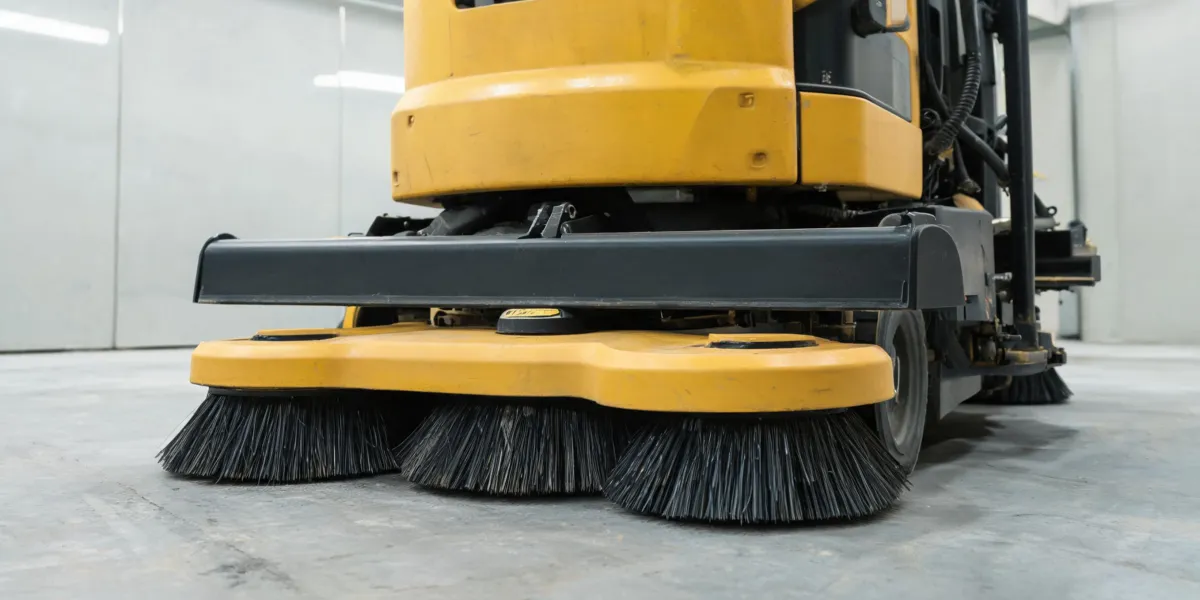
If your scrubber just stopped running, you don't need another 'best floor scrubber' list. You need a decision: repair, buy used, buy new, or rent something for the next few days. I coordinate parts and emergency repair service for commercial floor scrubbers and sweepers. Over the past three years, we have processed more than 200 rush parts and repair orders, and the first thing I learned is that there is no universal answer. There is only the right answer for your deadline, your budget, and your access to parts.
A quick terminology note. If you searched for 'driving floor scrubber,' I'm reading that as a ride-on scrubber, the machine an operator sits on. If you searched for 'used factory cat floor scrubber sheboygan' or 'commercial floor scrubber albuquerque,' you're already asking a more specific question. Those searches point to different scenarios, so they need different answers.
Which of these three situations are you in?
In my experience, the urgent calls fall into three patterns:
- A hard deadline and a dead machine. There is an inspection, an opening, or a production schedule, and the scrubber has stopped. Speed beats price.
- No hard deadline, but the budget only works if you buy used. You have time to shop carefully, but no room for a mistake. Documentation beats promises.
- No service relationship yet. You don't have a company to call when the machine does break. Availability beats brochure promises.
Scenario 1: Hard deadline, machine down
In March 2024, a food plant in Wisconsin called me at two in the afternoon on a Tuesday. Their ride-on scrubber had thrown an error code in the middle of a shift, and a third-party auditor was walking the floor Thursday morning. The brush-deck motor had a normal lead time of five to seven days. We checked the serial plate, confirmed the motor against the parts manual, found one at a supplier about 400 miles away, and paid $190 in overnight freight on top of the $240 component. The part arrived Wednesday morning, and the machine was running by lunch.
The client's alternative was renting a replacement for roughly $2,400 across two days. And if the part had not arrived, the audit could have gone very differently. My point is simple: in an emergency, new versus used is not the first question. The first question is whether anyone can get this exact machine running before your deadline.
I'm not a mechanic, so I am not going to pretend I can diagnose a dead hydraulic pump from a phone call. What I can say from the parts and logistics side is that precision saves time. If your machine shows an error code, write it down. Copy the model number and serial number. If you own a Factory Cat GTX, locate the 'factory cat gtx parts manual' and match it to the serial tag. The extra ten minutes at the start can save three days at the end.
If a repair can happen inside your window, repair. If it cannot, rent or borrow a machine to cover the gap, and make the permanent new-or-used decision after the deadline has passed. Buying any machine that has to travel for days is not an emergency plan.
Scenario 2: Budget says used, and you have time to shop
I have mixed feelings about used floor scrubbers. On one hand, a well-maintained Factory Cat XR or GTX can save a facility a large amount of money. On the other hand, one bad deal can burn through that saving in the first month. The difference is almost always documentation.
If one of your searches was 'used factory cat floor scrubber sheboygan,' location matters in a good way. Factory Cat's parts and service footprint is strongest in Wisconsin and Kentucky, so buying used close to that network means the next breakdown will not require a cross-country freight quote. That is worth something concrete when you compare total costs.
Before you make an offer on a used GTX or any Factory Cat model, open the parts manual. Actually, let me rephrase: open the manual before you walk out to inspect the machine. Check which part numbers match the serial number range. The most frustrating calls I take start with a buyer saying, 'the machine is in great shape,' and end with a part number that was changed after that model year. You'd think a low-hour machine would come with a clean service history. It almost never does.
If you are buying from a dealer and the ad claims 'low hours' or 'runs great,' remember the FTC's business guidance says advertising claims should be truthful and substantiated. The practical version of that rule: ask the dealer to show the maintenance records. A seller with a solid machine will not hesitate.
Do the arithmetic on total cost, not the listing price. Add freight, sales tax if any, and the likely first-service items such as batteries, belts, squeegee blades, and a fluid check. If the used total lands close to two-thirds of the price of a new machine, new equipment starts to make sense. If the used total is much lower, buy used and leave room in the budget for post-purchase service. I'm not sure where used prices sit in your market this month, so treat my two-thirds number as a rough test rather than gospel.
Scenario 3: How to compare floor scrubber companies before an emergency
If you don't yet have a service company you trust, the time to fix that is before the machine is down. Comparing floor scrubber companies is not hard, but the questions matter:
- Which brands and models do your technicians actually work on every week? A company that mostly repairs walk-behinds may still be slow on ride-on models.
- Do you stock common wear parts locally, or does everything come from a regional warehouse? This matters more than the brand name on the machine.
- Can you read error codes and work from technical manuals for older machines? If the answer is no, find out which models older than five years they will not touch.
- What does 'emergency call' mean in writing? Same day, next day, or a vague 'we will try' changes the whole risk calculation.
If your search was 'commercial floor scrubber albuquerque,' add one more question. Ask the dealer where parts will ship from when the machine needs service. If the regional stock is in Wisconsin or Kentucky, Albuquerque is not a same-day parts market. That does not mean buying is a bad idea; it means the dealer's local stock and technician response time matter more than the paint color.
The judgment guide: which scenario are you really in?
Here is a sixty-second check before you go down a rabbit hole of specifications:
- Deadline within the next three days? You are in Scenario 1. Call repair companies with your model, serial number, and error code, and ask about rental options. Do not spend the afternoon comparing new machine brochures.
- No deadline, but the budget only stretches to used? You are in Scenario 2. Give yourself a week or two, demand maintenance records, and confirm parts availability before you hand over money.
- No idea which company would come fix it? You are in Scenario 3, even if your current problem is also urgent. A service company that already knows your model is the quickest way to shorten every future breakdown.
Still not sure? Compare two numbers: the total repair cost and the total replacement cost. If the repair is less than about half of a working replacement and the part can arrive before your operation loses more money, repair the machine. If the repair is more than that, or the machine has a long history of failures, replacement is probably the better bet.
One more thing I have learned from emergency work: an informed customer makes a faster decision. You don't need to be a mechanic to ask good questions. You need to know your model number, your serial number, and what 'fast' really means to each company you call. Write those down before you pick up the phone, and you will save yourself a very expensive week.

Leave a Reply