I've been managing purchasing for a 210-person manufacturing company in Wisconsin since 2021. That means I handle everything from office supplies to industrial cleaning equipment—roughly $140,000 a year across fifteen vendors. I report to both our plant operations and the finance team, so I'm the one whose budget eats it when equipment underperforms.
If you're searching for a "factory cat 34 for sale," you're probably in the same position I was in: trying to figure out whether this machine is worth it, and whether new or used is the smarter call. Here's what I've learned the hard way: floor scrubber buying is not a price decision. It's a logistics decision and an application decision. A used Factory Cat in Sheboygan, Wisconsin is a completely different deal than the same model sitting in a Las Vegas equipment lot. And a machine that's perfect for a manufacturing plant can be the wrong answer for a hospital floor.
I'll compare new vs. used Factory Cat 34 floor scrubbers across three dimensions: real ownership cost, support and parts logistics, and application fit. I'll also give you an honest take on RPS floor scrubbers as an alternative, because they keep coming up in the same conversations. Fair warning: my conclusion won't be a tidy "buy new" or "buy used." It depends on where you are, what you're cleaning, and how much repair tolerance you have.
First, Some Context: The Factory Cat 34
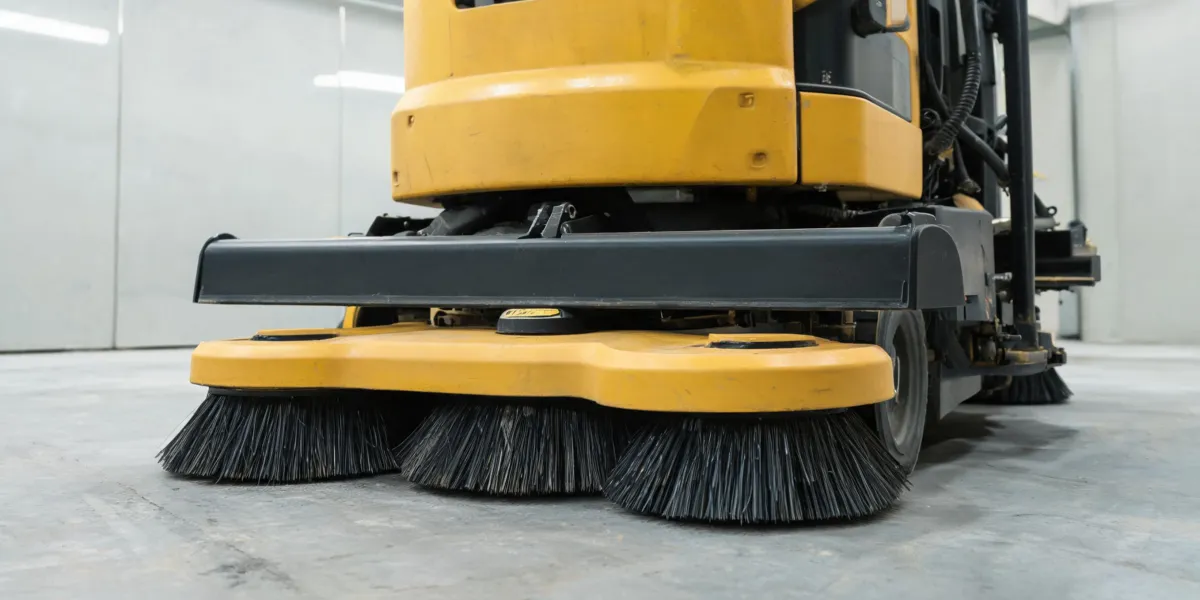
If you're new to this category, the Factory Cat 34 is a walk-behind floor scrubber with a 34-inch cleaning path. Per factory-cat.com, it's designed as a mid-duty industrial machine for smooth or slightly rough surfaces—concrete plant floors, warehouses, assembly areas. It's not a carpet extractor, not a burnisher, and not a clinical hospital scrubber. It sits in that busy middle category: more capable than a compact commercial machine, but not a giant ride-on.
I bought a used 34 in 2023 for our plant. I also helped a former colleague evaluate scrubbers for her warehouse operation in Las Vegas, and I've talked through hospital floor scrubber needs with a friend at a mid-sized regional medical center. So the comparison you're about to read is based on three different facility realities.
Dimension 1: Upfront Price vs. Total Cost of Ownership
Everything I'd read about used floor scrubbers said the same thing: avoid them. "You're inheriting someone else's problem." I believed that for two years, and it cost us money—because the "safe" alternative was paying new prices for machines we didn't always need.
In practice, the opposite held up. Our used Factory Cat 34 cost about 45% of what a new unit listed for, delivered from an equipment dealer in Sheboygan. The dealer supplied service records, the hour meter reading was honest, and the battery pack had been replaced six months before the sale. Based on dealer listings and auction results I've tracked between Q3 2024 and Q1 2025, used 34s in the Midwest are running roughly $6,500 to $12,000 depending on hours and condition—while a new configured unit lands closer to $18,000 or more. That gap is why this comparison matters.
Yes, I spent about $600 in the first months on new squeegee blades and a few hoses. That's still light-years cheaper than a new machine. But let me be honest about the risk calculation, because it kept me up before I signed: the upside was saving roughly $9,000. The risk was that one major service event—a drive motor, a control panel, an electronics failure—would eat those savings in a single repair. I kept asking myself: is $9,000 worth potentially three weeks of downtime while we wait for parts?
In our case, it was. We're in Wisconsin, where Factory Cat parts are a short shipment away, and our maintenance guy is comfortable with basic electrical diagnostics. But for a buyer far from that parts network, the math flips.
The bottom line on dimension one: used wins decisively for Midwest buyers who can inspect the machine and handle minor maintenance. The further you get from Factory Cat's home territory, the more risk you take on.
Dimension 2: Support Logistics — Sheboygan vs. Las Vegas
This is the dimension I almost never see in floor scrubber comparisons, and it's the one that causes the most buyer's remorse. Factory Cat's roots and parts infrastructure are concentrated in Wisconsin and Kentucky. That's not a secret—their site highlights those regional hubs. It's also why so many used Factory Cat machines appear in Sheboygan-area listings. Those machines were sold, serviced, and maintained locally, and if you're in that region, getting a part is a multi-day process at worst.
If you're in the Midwest, a used Factory Cat is close to a no-brainer. If you're not, the equation changes fast.
Let me tell you about the Las Vegas evaluation. A former colleague of mine manages a warehouse operation outside Vegas. Every spreadsheet analysis said the same thing: the used Factory Cat 34 she found at an online auction, priced about $7,500 below comparable used machines in the Midwest, was the financial winner. The numbers were that clear.
My gut said otherwise. Something felt off about buying a machine 1,600 miles from its support base. I went with my gut on that one—and let me just say I'm still grateful I did. Instead of the Factory Cat, she bought an RPS floor scrubber from a dealer with local service techs in Las Vegas. Same-week response when needed. With the Factory Cat, parts would have been special order, two weeks out minimum.
When I say support distance is a deal-breaker, I do not mean the machine is unreliable. Factory Cats hold up. I mean the support isn't there when you need it, and for a business that runs on equipment uptime, that absence is more expensive than any price premium.
The bottom line on dimension two: if you're in Sheboygan or the broader Midwest, buying used is one of the smartest equipment decisions I know. If you're in Las Vegas or another western market, I'd genuinely recommend a brand with local service infrastructure—and that often means an RPS machine or another national-service brand.
Dimension 3: Application Fit — Hospital vs. Industrial
This is where I'll probably annoy some Factory Cat loyalists. I'll say it plainly: I would not buy a Factory Cat 34 as a primary floor scrubber for a hospital.
The 34 was engineered for industrial floors, not patient corridors. When my friend at the regional medical center asked for advice, I walked through the hospital-specific needs with her:
- Quiet operation. Hospital cleaning happens around patients, often at night. The 34 is not whisper-quiet in a hard-floored corridor. It's not obnoxious, but it's noticeable.
- Infection control compatibility. Joint Commission standards for environmental cleaning expect that the equipment itself can be effectively cleaned and disinfected, and that any chemical delivery is precise and documented. The 34 was not designed with clinical chemical systems in mind.
- Maneuverability. The 34 handles open aisles well, but tight corners around patient beds and visitor furniture aren't where it shines.
She ended up choosing an RPS machine with a chemical metering system and quiet-mode options, set up by her local dealer. Honestly, I have mixed feelings about that recommendation—part of me wanted her to love the 34 as much as I love ours. But the hospital application is not what the 34 was built for. If your search is specifically for a "hospital floor scrubber," a Factory Cat 34 is not the answer I'd give you.
For industrial environments—the exact job the 34 is built for—it's one of the better value buys in this category. Concrete, sealed floors, machine shops, distribution centers: the 34 just works. Our floor crew learned it in one shift. The scrubbing deck is robust, and the pickup quality is genuinely good for a mid-size walk-behind.
The bottom line on dimension three: the Factory Cat 34 is an industrial workhorse. Buying it for a hospital setting is a square-peg-round-hole situation.
So Which Should You Buy?
Here's my straight answer, with conditions:
Buy a used Factory Cat 34 if:
- You're in the Midwest (Wisconsin, Kentucky, or nearby states) with reasonable access to parts and service.
- You're cleaning industrial concrete or sealed floors in a warehouse, plant, garage, or manufacturing space.
- You—or someone on staff—can handle basic maintenance like squeegee blades, brushes, and battery care.
- You can inspect the machine in person, verify hours, and check battery health before paying. If a seller can't show you the hour meter, that's a red flag.
Buy a new Factory Cat 34 if:
- You're outside the Midwest but still within service distance and need warranty-backed protection.
- You want predictable operating costs for the first few years and can amortize the higher initial price.
- Downtime is expensive enough that the warranty premium pays for itself.
Skip the Factory Cat entirely if:
- You're in Las Vegas or another western market without local Factory Cat service. Look at brands with local dealers, like RPS.
- You're buying for a hospital and need quiet operation, clinical chemical delivery, and easy sanitation. A purpose-built machine is the right call.
- You have zero mechanical capacity on staff. Every scrubber needs maintenance eventually. Without a service plan, a great value buy can become a very expensive paperweight.
Final Thoughts
I still kick myself for the first scrubber we leased—a budget machine that spent more time in the shop than on the floor. That mistake taught me to look at total cost of ownership instead of sticker price. But the Factory Cat 34 taught me something more nuanced: the best equipment for your facility isn't about the machine itself. It's about where you are, what you're cleaning, and who's going to keep it running.
If you're searching for a "used factory cat floor scrubber sheboygan," you're in a strong position, assuming the machine checks out. If you're searching for a "floor scrubber las vegas," you should be comparing RPS and other local-service options. Same brand, different regions, completely different recommendations.
That's not the tidy "one right answer" most articles give you. But it's the honest one—and honestly, honesty is what's been missing from equipment buying advice.

Leave a Reply