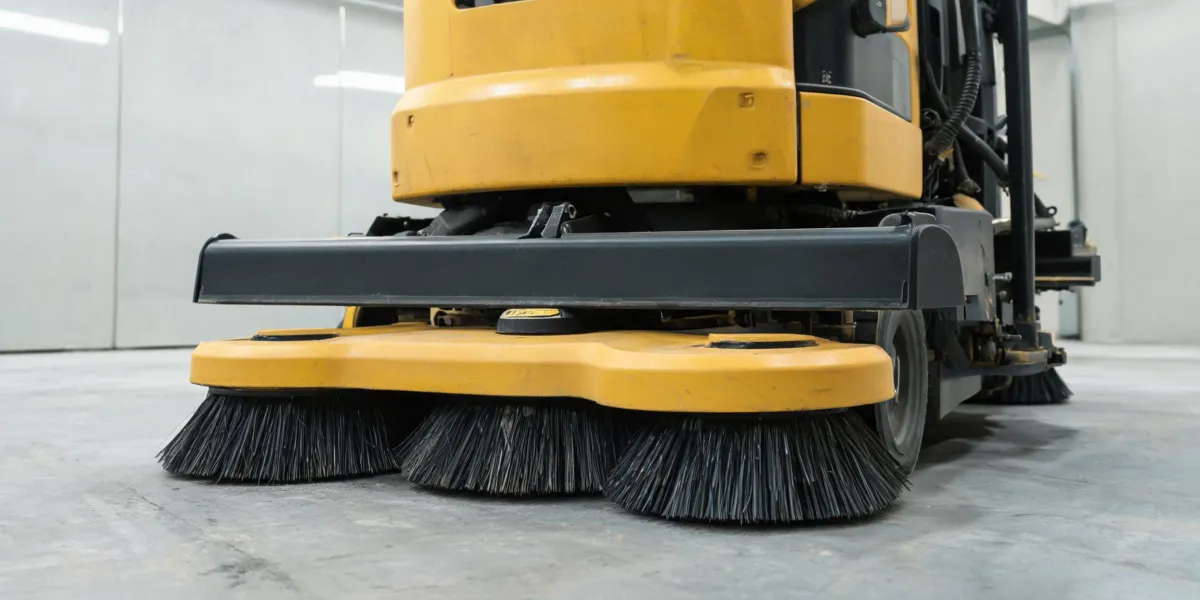
Buy the professional floor sweeper first. If I could go back to one purchasing decision in 2024, that is the advice I would give myself. After eight years of ordering floor equipment and Factory Cat parts, I keep a written list of my own mistakes. The costliest one was jumping to an autonomous scrubber before we had decent sweeping in place.
The mistake turned into roughly $11,000 in repairs, wasted labor, and downtime. Some of those invoices are still being sorted out. The scrubber itself was not junk. It was the wrong tool for the first step. An autonomous floor scrubber is a finishing tool, not a debris-removal tool. A Factory Cat floor sweeper is what handles debris first.
Here is how I reached that conclusion, what the LionsBot autonomous floor scrubber features actually taught me, and why Factory Cat scrubber parts deserve as much attention as the machine itself.
The Short Answer for Facilities Managers
A professional floor sweeper—what many crews call a broom sweeper machine—collects dry debris with a main broom and a side broom. It uses no water. A floor scrubber, on the other hand, applies water and cleaning chemistry, brushes the floor, and then vacuums the dirty water into a recovery tank. These are different steps in one process, not competing versions of the same process.
Too many buyers compare automation features before they compare the process. That was my exact mistake. A scrubber needs a floor that is already free of objects that can block its recovery shoes or shred its squeegee. Automation changes how the machine moves around a building. It does not change the physical limitation of a wet scrubber on large dry debris.
If the floor has wood chips, wrapping film, or dropped bolts, the scrubber will stop, drag debris around, or damage parts. That is not a robot brand problem. That is physics. Simple.
The Mistake That Cost Me Thousands
In April 2024, our capital budget was about to expire and one of our two cleaning positions was empty. I knew a robot scrubber would not solve everything, but the idea of filling a labor gap was tempting. I had two days to make the call. Under normal circumstances, I would demo a machine for a week and measure it in our actual building. There was no time for that. I approved the scrubber after a two-hour demo on a polished showroom floor.
The showroom had zero loose debris. Our real floor had stretch wrap, cardboard strips, sawdust, and a few lost bolts. The robot mapped the facility, avoided forklifts, charged itself, and sent me route reports. It also stopped often because its obstacle detection treated scraps as something it could not cross. We spent almost as much time untangling the robot as we would have spent cleaning manually.
I remember the week it tore its squeegee on a hose clamp. The service call and replacement part came to about $1,700, though I might be off by a few hundred. That was annoying, but it was not the real cost. The real cost was the two-person crew still doing manual pre-sweeping before the robot could run. The robot did not replace anyone. It added work.
Then the Factory Cat dealer suggested a simple test. Use a walk-behind sweeper before the robot route. We borrowed a Factory Cat 34 for one week. One operator walked the aisles, emptied the hopper, and left the floor dry. The robot started finishing its route. That is when I understood that the missing machine was not another robot. It was a sweeper.
What People Get Backwards
People think an autonomous scrubber is an upgraded sweeper. The assumption is that a computer-driven machine must also be better at handling dirt. Actually, automation advances how the machine navigates, not what the cleaning head can pick up. A scrubber still belongs to the wet-cleaning stage. A sweeper belongs to the dry-cleaning stage.
You do not buy an autonomous scrubber to replace a sweeper. You buy it to replace mopping. The sweeper still comes first.
This is one of those cases where the cleaning sequence fundamentals have not changed: remove dry soil, then wet clean, then polish or dry. What has changed is execution. In 2025, execution can be automated. The robot can scrub without a rider, but it should not scrub over material that belongs in a hopper.
At least, that has been my experience with industrial facilities. In a clean office with only dust, the order matters less.
LionsBot Autonomous Floor Scrubber Features I Evaluated
To be fair to the technology, the LionsBot autonomous floor scrubber features impressed me enough to start this whole project. I am not going to pretend the robot was useless. It proved that an autonomous scrubber can be a reliable piece of a cleaning system. The caveat is that it belongs after the sweeping step, not instead of it.
Three features stood out during our evaluation:
- Obstacle detection and automatic stopping: It protected people and racks, but loose debris triggered it too. On a pre-swept floor this was a safety feature. On a dirty floor it was a downtime generator.
- Auto-charging and docking: This was genuinely convenient because the operator did not have to babysit the battery. The dock needs a clear path, and the path has to stay clean.
- Cloud-based reporting: Supervisors like this. It shows runtime, area covered, and alerts. It does not show whether the floor looks clean, so we still spot-check with a walk.
For a facility that has its dry-debris process under control, a robot scrubber can be a no-brainer. For a facility that does not, the robot becomes the most expensive warning system you own.
Why Factory Cat Floor Sweepers Worked for Us
Our everyday solution ended up being a Factory Cat floor sweeper. The model range covers the sizes we deal with: the 34 and XR machine classes for loading docks and production aisles, Magnum models for wide warehouse runs, and Micro HD for tight areas. I am not going to recite spec sheets. What mattered to us was the design logic: the sweepers took the dry debris out of the way before water ever touched the floor.
The 34 we borrowed did its job without much training. It swept a route at walking speed, pulled debris into the hopper, and left the surface clean enough for the autonomous scrubber to finish. It did not replace the scrubber. It made the scrubber effective.
The Factory Cat Scrubber Parts Lesson
Parts are where I made a second mistake. After adding the sweeper to our fleet, I was ordering replacement squeegee blades and filters for our older ride-on scrubber. In a hurry, I ordered from memory. I wrote down the model name, skipped the serial number, and guessed at the part number. The result was a $190 brush that did not fit.
What I learned is simple: always order Factory Cat scrubber parts with the machine nameplate in front of you, and use the serial number if the dealer asks for it. Factory-Cat also publishes manuals and error-code documents on its website, so you can check the diagram before ordering. That small step would have saved me the reorder delay and a week of awkward conversations with our maintenance manager.
Where This Advice Does Not Apply
I do not want this to read as exactly what every facility should do. Boundaries matter.
If you run a climate-controlled facility with only light dust and fine debris, an autonomous scrubber by itself can be a reasonable investment. If you are dealing with only wet spill cleanup, a dedicated dry sweeper is less useful. If you have a combination sweeper-scrubber with a true debris hopper, that is a different equipment category and worth evaluating on its own.
But if you are asking whether LionsBot autonomous floor scrubber features can replace a broom sweeper machine, the answer from my spreadsheet is no. The robot scrubs beautifully after someone clears the floor of loose stuff. The broom still has to earn its keep first.

Leave a Reply