Comparing a $1.25 floor scrubber from Dollar Tree to a Factory Cat Mini Mag sounds like comparing a pocket knife to a table saw. But I've spent four years reviewing commercial cleaning equipment specifications, and I can tell you this comparison comes up more than you'd think. It usually starts when someone searches "floor scrubber virginia" or "factory cat floor scrubbers," then either gets overwhelmed by industrial spec sheets or tempted by a suspiciously cheap price tag.
I'm a quality compliance manager for a commercial equipment company. I review every floor scrubber before it ships—roughly 200+ unique items each year. In Q1 2024 alone, I rejected 14% of first deliveries: wrong brush heads, missing manuals, weld defects on frames that the vendor swore were "within industry standard." I mention that not to impress you, but so you know where my bias sits. I've processed several hundred equipment orders over four years, and the pattern of bad purchasing decisions is predictable.
The Real Question Isn't "Which Is Better?"
The obvious answer is the $10,000 machine. But that's not how purchasing decisions work. The real question is: which machine matches your actual workload, and what will it really cost you per hour of use?
The Dollar Tree unit costs $1.25. A Factory Cat Mini Mag costs somewhere in the $8,000–$15,000 range depending on age and condition—I'm not 100% sure on current dealer pricing, so don't hold me to that number. The gap looks enormous. But purchase price is the most misleading number on any spec sheet. Here's what I actually examine before approving a purchase.
Dimension 1: Build Quality vs. Duty Cycle
The Dollar Tree floor scrubber has a plastic handle, a threaded metal rod, and a sponge head about the size of your palm. It's designed for a bathroom countertop, a stove top, or a small spill on tile. Duty cycle: maybe 20 minutes of light scrubbing before the sponge degrades. And for that, it works. I tested one myself during a site visit last year. It cleaned a tile backsplash without scratching it. Honest product, correctly priced.
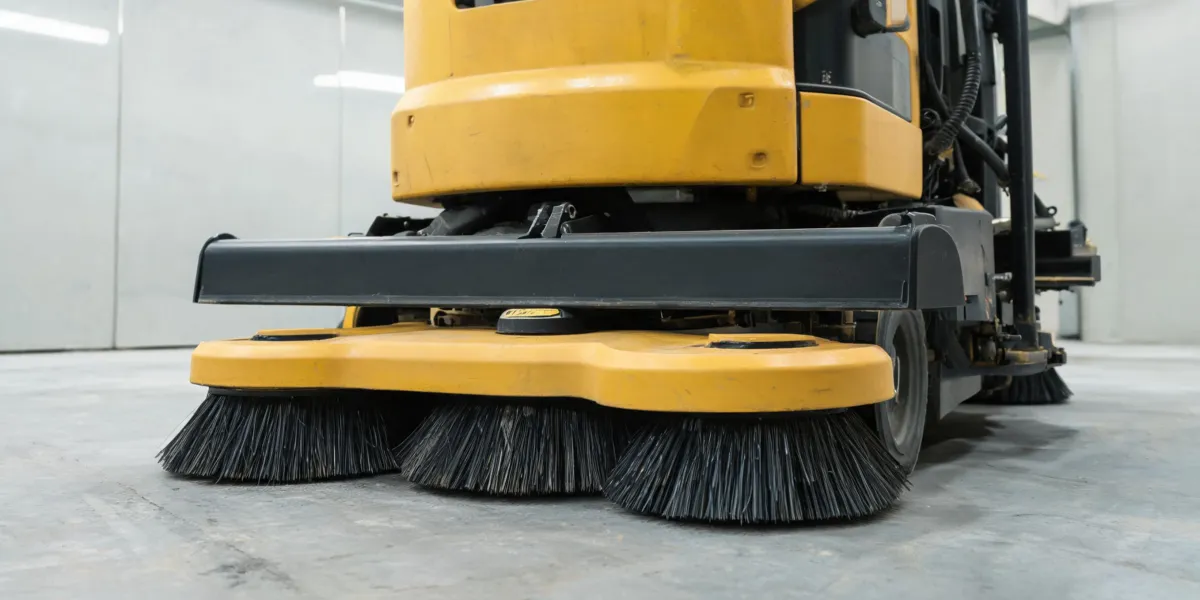
A Factory Cat Mini Mag is a different species. Welded steel frame, industrial casters, scrubbing deck rated for continuous eight-hour operation. The brand makes several models—the 34, XR, Magnum, Micro HD—but they all share that design intent: hours of daily use, serviceable parts, documented maintenance.
Here's the counter-intuitive part. I've rejected factory-new industrial scrubbers for quality problems more often than people expect. In late 2023, we rejected a whole batch because the weld seam on the handle brackets fell below our tolerance. The vendor pushed back. We held the line, and they redid the work at their cost. My point? Quality isn't a price tier—it's a verification process. The Dollar Tree unit is correctly built for its purpose. The Factory Cat is correctly built for a much harder one. The mistake is buying either without checking whether it matches what you're actually cleaning.
Dimension 2: Productivity—Square Feet Per Labor Hour
This is the dimension that ends the debate for commercial buyers. A person scrubbing by hand covers maybe 50 square feet per hour—bent over, rinsing the sponge, re-scrubbing the same spot. A person driving a Factory Cat floor scrubber covers 20,000+ square feet per hour standing upright. That's straight from the spec sheet, and it matches what I've observed on live job sites.
Run the math for a 40,000-square-foot warehouse, the kind I've spec'd equipment for in Virginia and elsewhere. One pass with a Mini Mag takes about two hours, including solution refill. The same floor scrubbed manually? 800 labor hours. Even at $10 per hour internal labor cost, that's $8,000 for a single cleaning. Do that weekly, and the industrial machine pays for itself fast.
Conclusion: for any commercial facility with floors that need regular scrubbing, the productivity gap alone decides the comparison. The Dollar Tree item stops being a contender before we even talk about durability.
Dimension 3: Total Cost of Ownership—Ask What's Not Included
I've learned to ask "what's NOT included" before "what's the price." That habit came from a specific failure. Everyone told me to check spec sheets before approving vendor quotes. I skipped it once on a rush order of scrubber pads because the deadline was tight. The "cheap" pads disintegrated after two weeks, cost me an $800 reorder, and delayed the whole project. I still kick myself for that one. The vendor's price had been honest; the quality had not.
Now look at the two machines through that lens.
The Dollar Tree scrubber is refreshingly transparent. No parts, no manuals, no support line, no error codes. When it breaks, you buy another one for $1.25. That's a complete transaction—nothing hidden, nothing to inspect.
The Factory Cat Mini Mag is transparent in a different way. Parts availability, service documentation, and error code support are published and real. Factory Cat's parts and service network is geographically concentrated in Wisconsin and Kentucky, which is great news if you're near those regions—lead times are short. If you're further away, that geography is still on the spec sheet; you just need to check your local distributor's stock before assuming same-week delivery. I've seen buyers skip that step and pay rush freight later. Don't be that buyer.
Per FTC advertising guidelines (ftc.gov), claims like "industrial-grade" or "long-lasting" must be substantiated. I apply that same standard to vendors I buy from: if a spec sheet doesn't list materials, duty cycle, or replacement parts, I treat the claim as suspect.
Here's the conclusion that typically surprises people: both units are honestly priced for what they are. The waste doesn't come from the product. It comes from matching the wrong category to the wrong workload. I've seen a facility buy a $12,000 industrial scrubber for a 2,000-square-foot retail space and watch it depreciate in a closet. I've also seen facilities save $800 on cut-rate replacement parts and lose $4,000 in labor before admitting the parts were the problem.
Dimension 4: The Mid-Tier Question—What About the Pringle Floor Scrubber?
I'm asked about the Pringle floor scrubber fairly often, and I'm not 100% sure why—regional popularity, maybe, or just brand recognition in a niche market. Take this with a grain of salt: I don't have enough firsthand review data to give you a confident Pringle vs. Factory Cat comparison.
What I can tell you: when the brands are comparable, the machine matters less than the support system around it. Before you choose between mid-tier options, get these four things in writing:
- The full replacement parts list with prices
- The owner's manual before purchase—if a vendor won't share it, that's a red flag
- Error code documentation and the warranty claims process
- Lead time for common consumables: brushes, squeegee blades, filters
That last item is the one most buyers skip. A machine with a six-week parts lead time isn't a tool; it's a museum piece. A machine with parts in stock locally is something you can build a maintenance plan around.
Which One Should You Buy?
Buy the Dollar Tree floor scrubber if: you're cleaning a bathroom, a countertop, or a space under 200 square feet. It's honest equipment at an honest price, and it'll do exactly what it promises.
Buy a Factory Cat Mini Mag (or one of their other models like the 34, XR, Magnum, or Micro HD) if: you're maintaining a warehouse, a manufacturing floor, or any facility over 10,000 square feet where mopping shows up as a recurring labor line item. The savings in labor hours alone typically justify the purchase within the first year.
And if you're choosing between mid-tier brands like Pringle and Factory Cat? Don't take my word for it. Take the documentation. Compare parts availability, service proximity, and manual quality. Call a local service technician and ask which brand they'd rather work on. Then buy the one that makes your maintenance life easier, not the one with the flashier brochure.
There's something satisfying about a machine still running five years after the purchase order, original manual still in the binder, local source for every consumable part. That's the outcome you're paying for. It just takes a little verification to get there.

Leave a Reply