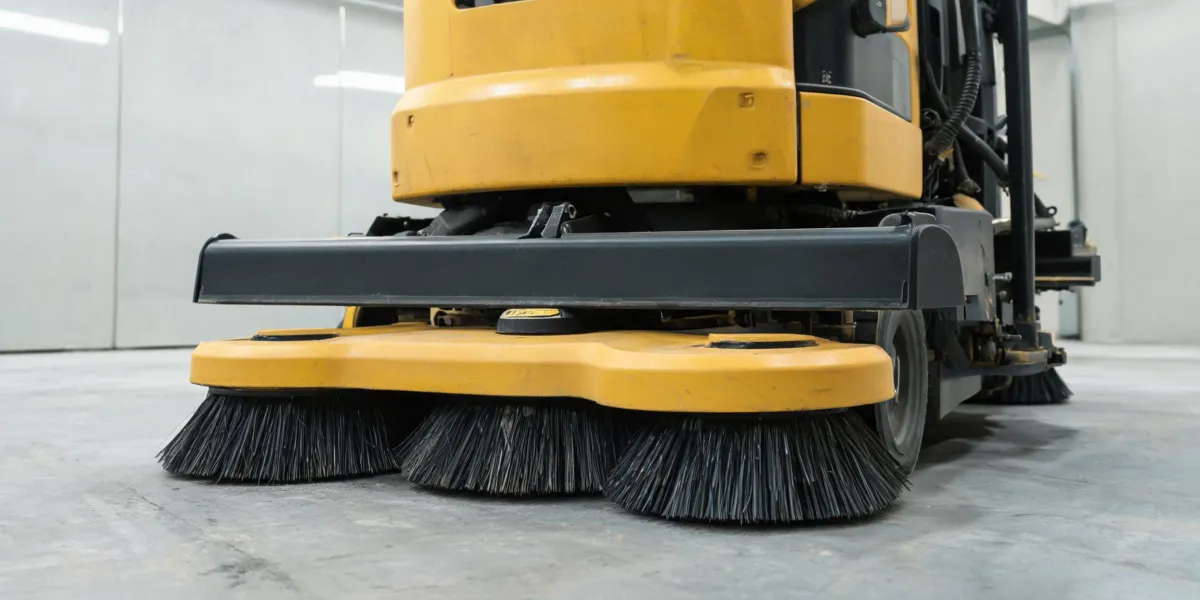
The best floor scrubber brands aren't the ones with the most advanced spec sheets. They're the ones with a parts-and-service network that can get you running again before a one-day repair turns into a two-week shutdown.
If that sounds overly simple, consider how most brand research actually gets done. Buyers compare scrub widths, tank capacities and battery runtimes. They choose a machine, sign the paperwork, and only later find out whether the brand has a support network that works for their location. I see the results of that mistake from the emergency side of the industry.
I work in parts and service dispatch for Factory-Cat, an industrial floor-cleaning equipment company. We build and support walk-behind sweepers and floor scrubbers from parts hubs in Greenfield, Wisconsin and Kentucky. In the last few years, I've handled 200+ rush orders, including same-day turnarounds for facilities that absolutely could not wait. One recent quarter alone, we processed 47 rush orders and kept a 95% on-time rate. This article is based on what I've seen after the sale, not on a sales brochure.
What Actually Separates the Best Floor Scrubber Brands
When I first started in this business, I assumed the best floor scrubber brands were the ones with the best engineering. I focused on cleaning performance and machine specs, the kind of thing any facility manager would research. That stuff matters, honestly. But after years of handling breakdown calls, I've changed my mind about where the real differences are.
One story I keep coming back to happened in March 2024. A warehouse outside Milwaukee called at 6:45 a.m. because a walk-behind sweeper had thrown a chain and damaged its brush deck. They had a client audit in two days, and their backup machine was already down, waiting on an imported part from another brand's national depot. That part had been in transit for over a week. We had the replacement deck assembly in stock at our Greenfield, WI facility, and it arrived the same day. The audit went ahead without a problem.
I tell that story not because it makes us look clever, but because the real lesson is about parts location. Our deck assembly wasn't magical. It was sitting a short truck ride from the customer. The other part was sitting in a central warehouse, probably a thousand miles away, waiting to be cross-shipped through a dealer. If you buy equipment without asking where the parts live, you're gambling in a way that only shows up after the machine stops working.
To me, the best floor scrubber brands share three characteristics that don't show up on a comparison chart:
- They keep repair parts close to their customers, not just in one national depot.
- They provide error-code support and repair documentation so maintenance crews can diagnose common problems.
- They respond like a partner when something goes wrong, not like the service request is an inconvenience.
Those factors decide whether a simple repair takes two days or two weeks. They are also hard to evaluate until you need them, which is exactly why so many buyers skip this step.
The 'Big Brand' Assumption That Fails
From the outside, it looks like buying from a well-known national brand means support is everywhere. The reality is more complicated. Many large brands rely on dealers, and dealer quality varies a lot. Some dealers are excellent and stock genuine parts. Many are basically sales offices. They will happily sell you a machine, but they don't carry meaningful inventory, so every parts order gets routed through a central system.
I've lost count of the calls where a customer says their well-known machine has been down for a week and the part is still in the system. That's not always the brand's fault. Centralized distribution is simply how big networks tend to work. But it's exactly why a regional manufacturer with a stocked parts hub can get you moving faster. It feels counterintuitive, but the biggest name in the industry isn't automatically the fastest when something breaks.
This is also why 'factory cat walk behind sweepers greenfield wi' shows up in search data for our area. People aren't typing the brand name by accident. They are looking for a walk-behind sweeper with genuine local support. Our parts hub in Greenfield means we can often get a part to a Wisconsin customer much faster than a competitor whose inventory sits in another state.
Don't Confuse a Floor Sweeper with a Floor Scrubber
If your search has been broad, pause on the machine class before you worry about brand names. A floor sweeper picks up dry debris like dust, dirt, packaging scraps and wood shavings. A floor scrubber washes the floor, applies water and cleaning solution, and scrubs away oil, stains and film.
Some facilities need one or the other. Many need both. If your main problem is loose dirt on a warehouse floor, a walk-behind sweeper is probably the right floor scrubber tool. If your floors are stained by lubricant or food residue, you need an actual scrubber. And if you've been searching for 'floor scrubber tool' as a category, use that as your starting question: are you cleaning up debris or cleaning the surface itself?
Walk-behind units make sense for smaller and mid-sized facilities. Factory-Cat's lineup includes compact models and larger machines, but the exact size matters less than having a machine your team can actually maintain. An oversized unit that can't maneuver through your aisles is wasted capacity. An undersized unit gets overworked and breaks more often.
Why 'Floor Sweeper Nearby' Is a Smarter Search Than You Think
Searching for a 'floor sweeper nearby' isn't just about shipping time. It's about local knowledge. A floor sweeper, and especially a floor scrubber, is a machine with brushes, squeegees, filters, solenoids and batteries. It will need maintenance. If your only route to support is a call center in another state, every hiccup becomes a bigger project than it should be.
This is where parts density matters. Facilities near our Greenfield, Wisconsin hub can talk to people who know these machines and can pull common wear parts off the shelf. Our Kentucky hub does the same for customers in the mid-South. For a facility in those regions, that kind of local support often outweighs the appeal of a slightly lower initial price from a distant brand.
Before you buy any sweeper or scrubber, ask the seller one direct question: 'If I need a brush deck or squeegee assembly next week, where does it come from?' If the answer is vague, take that as a warning. You are not looking for a company that can order parts. You're looking for a company that actually has them.
Small Customers Deserve the Same Support as Big Fleets
One pattern I dislike in this industry is how smaller customers are treated. A facility with one walk-behind sweeper often gets less attention than a distribution center with a fleet of 20 machines. I've known small business owners who were made to feel like their single-machine problem wasn't worth anyone's time.
Maybe that's why small-order service is a point of pride here. If you call with an $80 parts order for an older machine, we handle it the same way we handle a large fleet order. Last year I took a call from a small manufacturer who needed a brush and scraper blades for a Model 34 walk-behind unit. We shipped the parts and spent a few minutes on the phone helping them diagnose a wiper issue. Their machine was back in service the same week. That customer later sent us repair work, but even if they hadn't, it was still the right way to run a service desk.
If a supplier treats your small first order like an inconvenience, that tells you everything about the relationship later. The best floor scrubber brands, and the best parts-and-service operations, don't decide how attentive to be based on the size of your order. Small doesn't mean unimportant. It means potential.
When This Advice Doesn't Apply
I don't want to oversell the regional argument. If your company has facilities in five different states and needs one national service agreement, a large national manufacturer can be the right option. If you are located far outside the regions where a regional supplier has parts density, the local advantage mostly disappears. In those cases, a bigger network might genuinely be better for you.
There are also operations that maintain their equipment well and keep spare wear parts on hand. Those facilities can buy from a lower-cost brand because they have already factored longer repair lead times into their planning. That's a legitimate decision. What I'd argue against is making that decision without knowing you're making it.
Buy the machine as if it will break someday, because it will. The question isn't whether your sweeper or scrubber will need repairs. It's how your choice affects what happens after that first breakdown.
And if you landed here after searching for 'the biscuit factory cat lounge photos,' you've found a different kind of factory-cat. We don't run cat lounges and we don't have those photos. But if your biscuit factory's floors need real cleaning equipment, well, now you know where to find us.

Leave a Reply