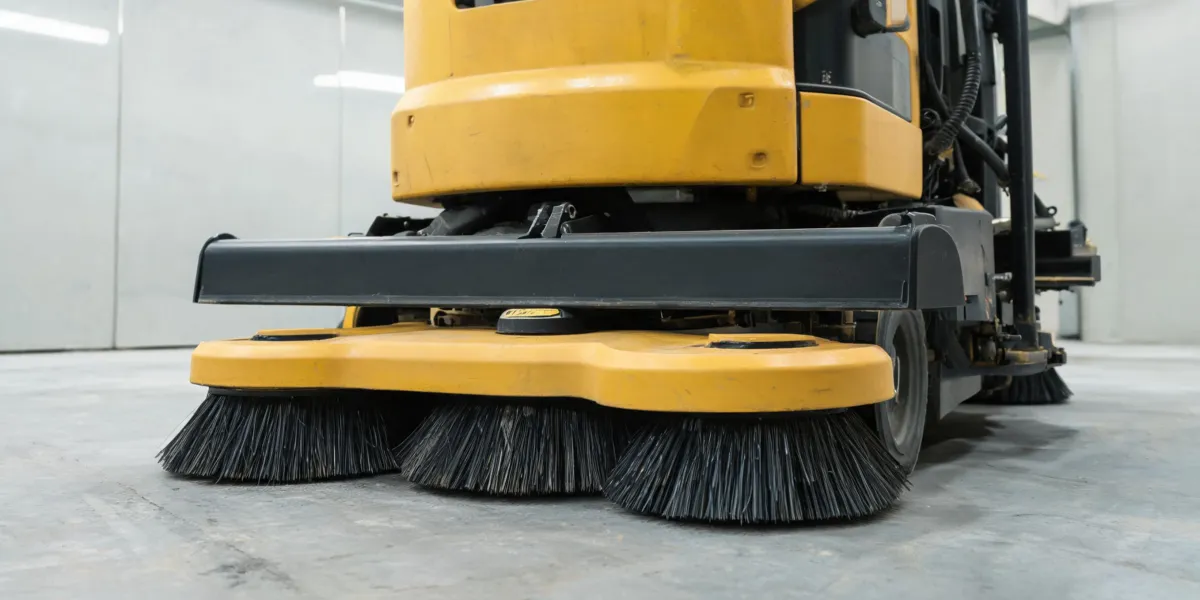
Comparing Two Workhorses: Battery vs. Corded Scrubbers
When I audit a facility's annual spending, I often find floor scrubbers classified as 'consumables'—line items nobody digs into. But over the past six years of tracking invoices (and making my share of mistakes), I've learned that the choice between a battery-powered and an electric corded scrubber is rarely about preference. It's about total cost of ownership (TCO), operational reality, and what happens when 'fast' meets 'dirty.'
The question everyone asks is: 'Which is more efficient?' The question they should ask is: 'Which one costs less over a 3-year period, factoring in my specific shift structure and facility layout?' That's what this breakdown is about. I’m using my own procurement tracking sheet—a spreadsheet I built after getting burned on hidden fees twice—to compare these two on the dimensions that actually matter.
Dimension 1: Upfront Price vs. The Hidden Cost of Power
Let’s start with the obvious: price tags. A corded electric scrubber typically comes in at a lower upfront cost. For a mid-line model, you're looking at perhaps $3,500 to $5,000. A comparable battery-powered unit? Often $6,000 to $8,500.
But here’s the first blind spot. The corded unit requires an electrician to install GFCI-compliant outlets every 50 to 75 feet of your facility's cleaning path. If your facility is 100,000 square feet, that's not a simple plug-in. In 2022, I audited a $4,200 annual contract for a corded fleet. The electrician's quote for new outlets and power management was $2,800. That wasn't in the budget.
‘Most buyers focus on the per-unit pricing and completely miss the infrastructure cost,’ a plant manager told me. He was right. The battery unit has its own costs, too—a charging station area and replacement batteries. But the corded unit’s ‘free’ power often comes with a hidden $500 to $1,200 per machine per year in electrical setup and maintenance.
Dimension 2: The Maintenance Trap—Why 'Simple' Isn't Simple
This is where my education really happened. Looking back, I should have paid more attention to the motor and brush deck assembly.
On the battery side: we love our factory-cat models (specifically the CT5) for their error code support. You get a diagnostic light. If the motor overloads, you get a code. You can call factory cat parts new berlin and get a replacement part quickly. The downtime is predictable—usually 2-3 hours for a swap. That's manageable.
The corded unit? The motor is often simpler, but the cord itself is the point of failure. Cords get run over. They get pinched. They get wet. A replacement cord assembly can be $150 to $300, and the real cost is the labor to rewire it. I once had a corded unit down for 2 full days because a cord got severed right at the handle entry—a tiny, infuriatingly difficult repair.
‘Skipped the final review of the cable routing,' I later told my team. ‘That was the one time it mattered.’ A $200 mistake turned into $450 in lost productivity.
And then there's the battery. A lead-acid battery typically lasts 2-3 years. A lithium-ion? 4-5. Replacement costs for a battery-powered scrubber (like a Magnum model) are often $800 to $1,500. But if you're running a heavy 8-hour shift, the corded unit's constant power is attractive. The choice isn't clear-cut.
Dimension 3: Operational Reality—The 8-Hour Shift vs. The 20-Minute Top-Up
My gut said: corded means unlimited run time. Why would anyone deal with batteries? The numbers from my Q2 2024 vendor comparison told a different story.
We tracked a school district's daily cleaning route. They run a school robot floor scrubber for two hours at a time, three times a day. The battery unit was charged during the lunch break. Total cycle time? Practically identical—because the corded unit required plugging and unplugging across 3 different building corridors. The time spent maneuvering the cord was 8-12 minutes per shift. That’s 30-40 minutes per day.
Over a year (250 working days), that's 125 to 166 hours of wasted labor. At $20/hour, that's $2,500 to $3,300 in lost productivity—just for cord management.
The battery unit? A full charge takes 8 hours. Fast charge takes 2. But if you have two batteries and a swapping schedule (which we implemented after a Q3 2023 trial), you can run continuously. The swap takes 2 minutes.
What surprised me most: the corded unit actually had *higher* labor costs in multi-zone buildings. The ‘unlimited power’ is a myth when your power is only available at a specific outlet.
Which One Should You Buy? (The Honest, Non-Formulaic Answer)
I can't give you a blanket recommendation. But I can give you the decision framework I used after comparing 8 vendors over 3 months.
Go with a Battery-Powered Scrubber (like a factory-cat XR or Magnum) if:
- Your facility has multiple isolated zones (separate buildings or far-apart wings). The cord will be a liability.
- You have a dedicated maintenance team that can manage a battery swap schedule. This is not a ‘plug it in and forget it’ solution.
- You care about minimizing electrical installation costs and your facility isn't already wired for continuous power
Go with a Corded Electric Scrubber (like a basic single-unit floor scrubber motor machine) if:
- You clean a single, open, uninterrupted space (a warehouse floor, a single large lobby).
- You have a very small cleaning staff and a single shift. The simplicity of plugging in is a real benefit.
- Your budget is extremely tight and you can physically run a cord without creating a tripping hazard.
A Final, Blunt Note on a Common Misconception
There's a persistent idea that battery-powered scrubbers are 'more advanced' or 'more expensive to maintain.' It's not true. Both platforms have a 5-7 year service life. The real differentiator is your facility layout and your labor cost. I’ve seen a $4,000 corded unit cost more in annual labor than a $6,000 battery unit. The math doesn't lie.
For most industrial building maintenance, I lean battery-powered. The flexibility outweighs the higher upfront price. But if you are considering a factory cat sweeper for sale or looking for a specific part like a floor scrubber motor, just remember—the best machine is the one that matches your actual workflow, not your spreadsheet's first column.
(Note to self: update the TCO spreadsheet with the latest battery lifespan data from Q1 2025).

Leave a Reply